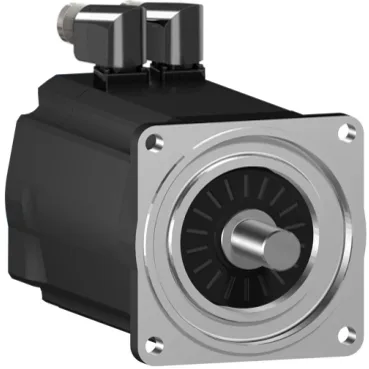
Speed and torque depend on your supply voltage
The SH31001P01A2100: The nominal speed and torque are not single numbers — they shift with the input voltage. On three-phase 400 V or 480 V, the motor delivers 5000 rpm or 6000 rpm respectively, with 2.27 Nm nominal torque. On single-phase 115 V, speed drops to 1250 rpm with 2.91 Nm; on 230 V single-phase, 2500 rpm at 2.64 Nm. Continuous stall torque is 2.94 Nm across the 115-480 V three-phase range, and peak stall torque hits 9.6 Nm — useful for short acceleration bursts or overcoming static friction. Continuous power is listed at 1190 W, but nominal output power varies from 410 W (115 V single-phase) up to 1630 W (480 V three-phase). Match the drive supply to the application duty cycle.
Encoder, sealing, and mechanical fit
Absolute single-turn SinCos Hiperface encoder — position is known immediately on power-up, no homing sequence needed. The resolver-equivalent SinCos signals work with most Schneider and third-party servo drives that support the Hiperface protocol. IP65 rating on both the motor body and the shaft bushing per IEC 60034-5. This is a washdown-capable motor — suitable for food-and-beverage lines or wet environments where hose-down cleaning is routine. 100 mm international standard flange with a 95 mm centring collar and 9 mm mounting holes. Smooth shaft, 19 mm diameter, 40 mm shaft length. The rotatable right-angled connector lets you orient the cable exit in the field — useful when the motor is tucked into a tight frame. No holding brake on this variant — the load must be held externally (mechanical brake, Z-axis counterbalance, or the drive's holding torque at standstill). If the application requires a brake, this is not the right order code.
Electrical parameters for drive tuning
Stator resistance 3.8 Ω, stator inductance 9.5 mH, 4 poles. Torque constant 0.84 Nm/A at 120 °C copper temperature; back EMF constant 60 V/krpm at 20 °C. These are the numbers the servo drive auto-tuning routine needs for current-loop gains. Continuous stall current is 3.5 A; maximum RMS current (3-second peak) is 12.0 A. The drive's peak current rating must support this for acceleration moves. Natural convection cooling — no external fan or forced air required. The thermal limit is set by the 130 °C copper hot-spot temperature.
Radial and axial load limits
Maximum radial force Fr at the shaft nose depends on speed: 900 N at 1000 rpm, dropping to 530 N at 5000 rpm. Maximum axial force Fa is 160 N. These are the bearing load limits — belt drives or overhung pulleys must stay within the curve.