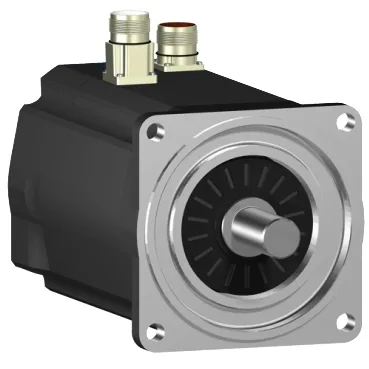
1190 W servo motor with holding brake — SH31001P01F1200
The SH31001P01F1200 is a Schneider Electric SH3 series servo motor with an integrated holding brake, rated for 1190 W continuous power. It's a three-phase motor with a 100 mm flange and a smooth shaft, built for applications that need a positive stop when power is removed — think vertical-axis gantries or Z-axis stages where the load must not drift. The holding brake delivers 9 N·m (79.7 lbf·in) of holding torque, which is separate from the motor's nominal torque. That means the brake holds the load at rest even when the drive is off, without relying on the motor's magnetic detent or a mechanical lock.
Speed and torque across supply voltages
This motor's speed and torque vary significantly with the input voltage. On 400 V three-phase, nominal speed is 5000 rpm with 2.27 N·m nominal torque; on 480 V three-phase, it reaches 6000 rpm at the same torque. On single-phase 115 V, nominal speed drops to 1250 rpm with 2.91 N·m, and on 230 V single-phase it's 2500 rpm at 2.64 N·m. The peak stall torque is 9.6 N·m across the 115–480 V three-phase range. Continuous stall torque is 2.94 N·m across the same three-phase range, and the motor can deliver 12.0 A peak for 3 seconds. The torque constant is 0.84 N·m/A at 120 °C copper temperature, and the back EMF constant is 60 V/krpm at 20 °C — useful numbers for tuning the drive's current loop and setting the velocity observer.
Encoder, IP rating, and mechanical fit
The encoder is an absolute single-turn SinCos Hiperface type — single-turn means it reports position within one revolution at power-up without a homing move. The motor carries an IP65 rating on the housing and shaft bushing per IEC 60034-5, with IP67 on the housing itself. That makes it suitable for washdown environments, though the connector must be mated properly to maintain the seal. Mechanically, it uses an international standard flange with a 100 mm centring collar diameter and 3.5 mm depth. The smooth shaft is 19 mm diameter by 40 mm long. The electrical connection is via a rotatable right-angled connector or a straight connector — both options are listed, so you can route the cable in the direction that fits your cable tray or drag chain.