Motor sizing for the cycle budget
The SH31001P0BA4100 delivers 2.64 N·m nominal torque at 400 V three-phase and 1190 W continuous power — enough to accelerate a moderate inertial load through a pick-and-place cycle without oversizing the drive. Peak stall torque hits 9.6 N·m across the 115–480 V three-phase range, giving headroom for short-duration acceleration or deceleration events that would otherwise stretch the cycle time. The absolute multiturn Hiperface DSL encoder eliminates the need for a home sequence on power-up — the motor knows its position as soon as the drive synchronises, which shaves seconds off each start-up and matters in multi-axis cells where every handshake counts.
Supply voltage and torque mapping
Nominal torque drops to 2.27 N·m when fed from 400 V or 480 V three-phase, and to 2.64 N·m at 230 V single-phase — the motor's output is supply-dependent, so the drive's input voltage directly sets the available torque at rated speed. Nominal speed varies similarly: 2500 rpm at 230 V single-phase, 5000 rpm at 400 V three-phase, and 6000 rpm at 480 V three-phase. A machine designed for 5000 rpm on a 400 V line will lose half the speed if wired to a 230 V single-phase supply — the supply choice is the speed range choice. Continuous stall torque is 2.94 N·m across the full 115–480 V three-phase range, with a continuous stall current of 3.5 A — this is the holding torque available at zero speed without thermal overload, useful for clamping or indexing applications.
IP65 and environmental sealing
Natural convection cooling (no fan) keeps the envelope clean but limits duty cycle in high-torque applications — the 1190 W continuous rating assumes free airflow around the flange-mounted body.
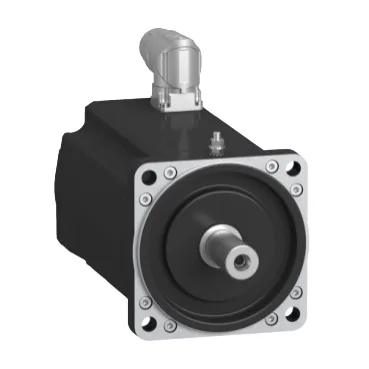
No pin-compatible alternative exists within the SH3 family that matches this encoder type and flange size. If a second source is needed, the motor's electrical and mechanical interface (100 mm flange, smooth 19 mm shaft, Hiperface DSL) must be matched exactly to avoid a board or coupling redesign.