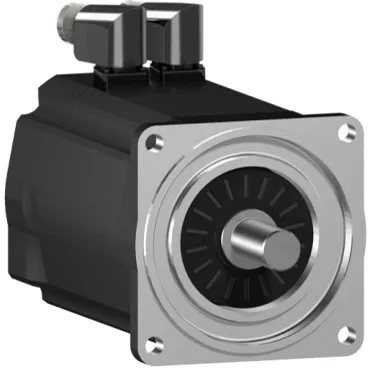
Speed and torque across supply voltages
The SH31001P12F2100 delivers 5000 rpm at 400 V three-phase and 6000 rpm at 480 V three-phase; on single-phase 230 V it runs 2500 rpm, and on 115 V single-phase it runs 1250 rpm. Nominal torque varies with supply: 2.91 N·m at 115 V single-phase, 2.64 N·m at 230 V single-phase, and 2.27 N·m at both 400 V and 480 V three-phase. Continuous power output follows the same pattern: 410 W at 115 V single-phase, 790 W at 230 V single-phase, 1410 W at 400 V three-phase, and 1630 W at 480 V three-phase. The motor's continuous power rating is 1190 W, so the 400 V and 480 V three-phase figures exceed that — the drive must limit current to stay within the thermal envelope.
Holding brake and encoder — what they mean for a motion axis
The holding brake delivers 9 N·m (79.7 lbf·in) of holding torque — enough to keep a vertical load stationary when the drive is disabled. The brake is engaged at rest; the drive must release it before motion starts, and the holding torque figure is the static rating, not a dynamic braking torque. The absolute multiturn SinCos Hiperface encoder reports position even after a power cycle — no homing sequence needed on startup. This is a single-cable feedback interface (Hiperface) that carries both power and data, simplifying the cable chain compared to separate encoder and motor power cables.
Mounting and environmental fit
The motor uses an international standard flange with a 100 mm (3.9 in) flange size and a 19 mm (0.7 in) shaft diameter with a parallel key. The centring collar depth is 3.5 mm (0.1 in) — confirm the mating pilot bore depth on the gearbox or load side to avoid axial interference. Cooling is natural convection, so the motor relies on its own surface area and the mounting flange for heat dissipation; no external fan is fitted.
Electrical parameters for drive tuning
Stator resistance is 3.8 Ω and stator inductance is 9.5 mH — these set the electrical time constant and influence the current-loop tuning in the servo drive. The torque constant is 0.84 N·m/A at 120 °C copper temperature, and the back EMF constant is 60 V/krpm at 20 °C — both needed for the drive to calculate the correct current command for a given torque demand.