1100 W servo, speed-torque curve spans 500–2400 rpm
The SH31002M01A1000 is a 1100 W continuous-power servo motor from the SH3 series, designed for three-phase supply but also specified for single-phase 115 V and 230 V inputs — the nominal speed shifts with the supply voltage: 500 rpm at 115 V single-phase, 1000 rpm at 230 V single-phase, 2000 rpm at 400 V three-phase, and 2400 rpm at 480 V three-phase. Nominal torque runs 5.28–5.62 N.m (46.73–49.74 lbf.in) across the same voltage range, so the motor delivers comparable torque whether fed from a single-phase or three-phase drive — the drive must supply the correct voltage profile to hit the target speed-torque point.
Absolute Hiperface encoder — drive compatibility check required
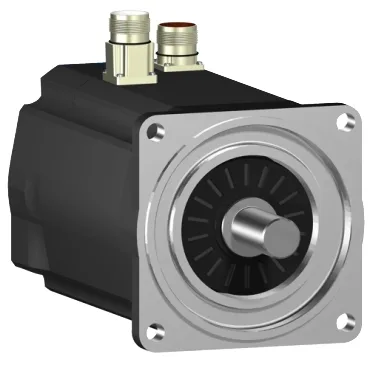
Feedback is via an absolute single-turn SinCos Hiperface encoder — this is a specific interface protocol that determines which drive families are compatible. Not all servo drives support Hiperface; the drive's encoder input card must match the SinCos absolute single-turn format. The electrical connection is a straight connector, smooth shaft end (no keyway), shaft diameter 19 mm, shaft length 40 mm. The motor flange is the international standard 100 mm flange with a centring collar diameter of 95 mm. IP rating is IP54 at the shaft bushing without the shaft seal ring, rising to IP65 for the motor body and IP65 for the shaft bushing when the seal ring is fitted — the IP65 rating is conditional on the seal being installed, not inherent.
No official successor or cross-reference is listed for this SH3 frame size — the SH31002M sizing reference is the base identifier; the -01A suffix denotes the specific encoder and connection variant.
Stall current and thermal limits for drive sizing
Continuous stall current is 2.5 A — the drive must be rated to deliver this continuously at standstill without exceeding thermal limits. Peak current (3 s) is 9.0 A, which sets the acceleration torque ceiling. Stator resistance is 8.6 Ω and stator inductance is 24.3 mH — these values affect the drive's current-loop tuning and the maximum switching frequency before iron losses dominate. The motor has 4 poles and is cooled by natural convection, so no external fan is required but the mounting surface must allow free airflow.