Speed and torque map by supply voltage
The SH31002M01A1100: Nominal speed spans 500 rpm on 115 V single-phase up to 2400 rpm on 480 V three-phase, with corresponding nominal torque from 49.74 lbf·in (5.62 N·m) down to 46.73 lbf·in (5.28 N·m). The motor delivers 1100 W continuous power, so the drive must be sized for the voltage and speed the application demands. Peak stall torque is 162.0 lbf·in (18.3 N·m) across the 115…480 V three-phase range, giving a 3.5× overload capability over the continuous stall torque of 51.3 lbf·in (5.8 N·m). This is the figure to check for acceleration and emergency-stop torque requirements.
Absolute SinCos Hiperface feedback — no homing cycle
The encoder is an absolute single-turn SinCos Hiperface type. On power-up the drive reads the absolute position within one mechanical revolution, so the machine does not need a homing sequence after each power cycle. Single-turn means position is unique within one revolution; multi-turn applications need an external reference or a multi-turn encoder variant. The torque constant is 2.32 N·m/A at 248 °F (120 °C) copper temperature, and the back-EMF constant is 146 V/krpm at 68 °F (20 °C). These numbers set the current-loop gain and the voltage limit for the drive at high speed.
IP65 and mechanical limits for integration
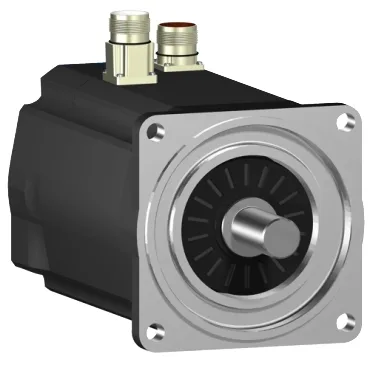
Natural convection cooling means no external fan or compressed air is needed, but the thermal budget depends on the mounting surface and ambient air flow. Maximum radial force Fr derates with speed: 990 N at 1000 rpm, down to 620 N at 4000 rpm. For belt-drive or overhung-load applications, the actual radial load at the operating speed must stay below the curve. Maximum axial force Fa is 160 N. Smooth shaft, 19 mm diameter, 40 mm shaft length, 6 mm keyway. Mounting is via an international standard flange with a 100 mm flange size and a 95 mm centring collar diameter. The straight electrical connector exits axially — plan cable routing and bending radius accordingly.