Motor ratings that shift with the supply voltage
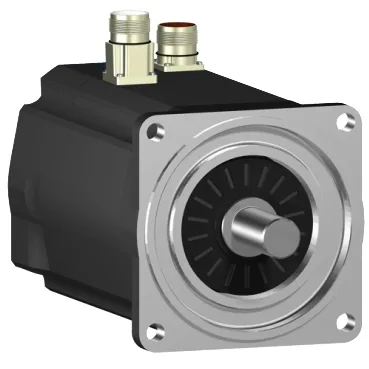
The SH31002M01F1000's nominal speed and torque are not fixed; they depend on the supply voltage and phase configuration. At 400 V three-phase, nominal speed is 2000 rpm with 5.28 N·m nominal torque; at 480 V three-phase, speed reaches 2400 rpm with the same torque figure. On single-phase 230 V, the motor delivers 1000 rpm and 5.5 N·m, while at 115 V single-phase it drops to 500 rpm and 5.62 N·m. This voltage-dependent behavior means the BOM must specify the drive supply voltage before the motor's rated point can be confirmed for the application. Continuous stall torque is 5.8 N·m across the 115...480 V three-phase range, and peak stall torque reaches 18.3 N·m over the same range — useful for sizing acceleration torque in a pick-and-place cycle without oversizing the drive.
Brake and encoder — what the holding torque and feedback mean for fit
The absolute single-turn SinCos Hiperface encoder provides position feedback at power-up without a homing cycle, which simplifies commissioning on multi-axis lines where the machine must know its position immediately after a power cycle. Single-turn limits the absolute range to one revolution; multi-turn applications will need a different encoder option or a homing routine.
IP rating and shaft seal — what the construction allows
The motor carries IP65 protection when the shaft bushing includes a seal ring, and IP54 without it, per IEC 60034-5. The smooth shaft end and 19 mm diameter with 6 mm keyway are standard for coupling to a load without custom machining.