Motor specs that decide the swap
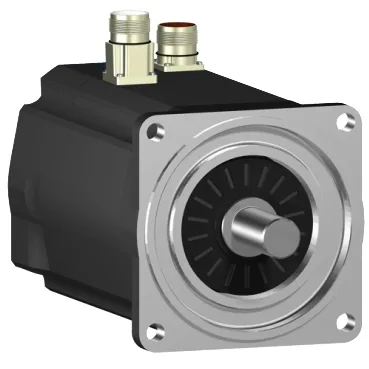
The SH31002P02F1100 is a three-phase servo motor from the SH3 family, rated 1.9 kW continuous power with natural convection cooling — no external fan to fail or wire. It carries a holding brake rated 9 N.m (79.7 lbf.in), which locks the shaft at standstill — critical for vertical-axis applications where the load must not drift when the drive is disabled. The absolute multiturn SinCos Hiperface encoder eliminates the need for a home-find sequence after a power cycle; the drive knows the rotor position on power-up, so the machine can resume from where it stopped.
Speed-torque curves across supply voltages
Nominal speed varies with line voltage: 1000 rpm on 115 V single-phase, 2000 rpm on 230 V single-phase, 4000 rpm on 400 V three-phase, and 4800 rpm on 480 V three-phase — the same motor frame covers multiple supply configurations without a hardware change. Nominal torque also shifts: 5.5 N.m at 115 V single-phase, 5.2 N.m at 230 V single-phase, 4.6 N.m at 400 V three-phase, and 4.4 N.m at 480 V three-phase — the torque drops as speed increases, typical of the constant-power region. Peak stall torque is 18.3 N.m across the 115–480 V three-phase range, with continuous stall torque at 5.8 N.m — the motor can deliver short bursts for acceleration without exceeding thermal limits.
Mounting and mechanical fit
The motor uses an international standard flange with a 100 mm (3.9 in) flange size, a 95 mm centring collar, and a 3.5 mm centring collar depth — it drops into the common 100 mm flange pattern used across the SH3 family. The smooth shaft is 19 mm diameter, 40 mm long — no keyway, so the coupling must clamp onto the shaft or use a keyless locking mechanism.
Electrical parameters and connection
Stator resistance is 2.4 Ohm per phase, inductance 6.75 mH — these values set the electrical time constant and influence the drive's current-loop tuning. Maximum continuous current is 17.1 A RMS; the same figure applies for the 3-second peak current — the drive must be sized to deliver this without tripping on overcurrent. The torque constant is 1.21 N.m/A at 120 °C copper temperature, and the back EMF constant is 77 V/krpm at 20 °C — these allow the drive to calculate the torque from current feedback and estimate speed from the back EMF. Electrical connection is via a straight connector — no right-angle adapter needed, so the cable exits axially, which matters when the motor is mounted in a tight enclosure or against a wall.
Mechanical load limits
Maximum axial force is 160 N — the bearing can handle moderate thrust loads from helical gears or belt tension, but a thrust bearing may be needed for higher axial loads. Maximum radial force depends on speed: 990 N at 1000 rpm, dropping to 620 N at 4000 rpm — the bearing life is derated at higher speeds, so overhung loads (pulleys, gears) must be checked against the curve.