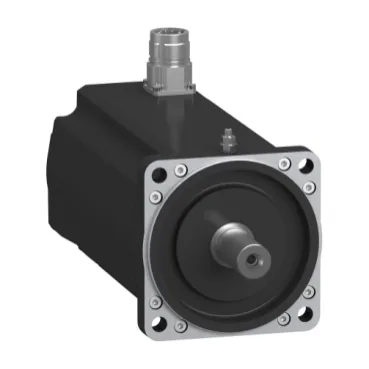
Motor torque and speed — voltage-dependent output
The SH31002P0BA3100 delivers 5.2 Nm at 2000 rpm on 230 V single-phase input, 4.6 Nm at 4000 rpm on 400 V three-phase, and 4.4 Nm at 4800 rpm on 480 V three-phase — the torque curve shifts with the supply voltage, not just the speed command. Continuous power is 1930 W on 400 V or 480 V three-phase, dropping to 1090 W on 230 V single-phase. The motor is wound for three-phase operation; the single-phase figure is a derated mode, not the design point.
Encoder and feedback — Hiperface DSL absolute multiturn
The absolute multiturn Hiperface DSL encoder eliminates the need for a home cycle on power-up — position is known at boot. The DSL protocol runs over a single cable pair, combining power and data, which simplifies the cable chain compared to separate encoder and motor power cables. The straight quicklock connector mates to the motor body; no field-wiring of the encoder is required if the mating cordset is pre-terminated. The IP65 rating on both the motor and shaft bushing means the encoder electronics are sealed against washdown — no secondary potting needed.
No holding brake — sizing for vertical or high-inertia loads
This variant ships without a holding brake. For vertical-axis applications or loads that must hold position at power-off, an external brake or a motor with an integrated brake (same frame, different suffix) is required. The smooth shaft end accepts a customer-supplied brake pulley or coupling, but the motor itself provides zero static holding torque.
Cooling and thermal limits — natural convection only
Cooling is by natural convection only — no integrated fan or forced-air duct. The motor relies on the mounting flange and ambient air movement to dissipate heat. Continuous stall current is 4.8 A; the maximum continuous RMS current is 17.1 A, but that figure assumes adequate heat sinking and ambient below the copper hot-spot limit of 130 °C. Stator resistance is 2.4 Ω and inductance is 13.5 mH — these values set the electrical time constant and influence the current-loop tuning gains in the drive. The back-EMF constant is 77 V/krpm at 20 °C, which means at 4000 rpm the motor generates about 308 V line-to-line; the drive DC bus must stay above this to maintain current control.