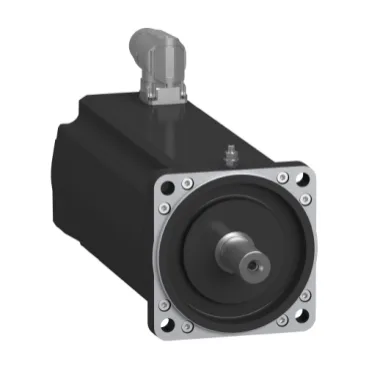
Motor envelope and mechanical interface
The SH31002P0BF4100 carries a 100 mm international standard flange and an overall length of 235.5 mm, so it fits the IEC frame-size envelope common to European-sourced machine builds. The smooth shaft measures 19 mm diameter by 40 mm long, which mates with a standard shaft clamp or keyless coupling — no keyway to clock, so the encoder zero-set happens at the drive, not the shaft. Centring collar depth is 3.5 mm; mounting holes are 9.0 mm diameter on the flange face. The motor is naturally convection-cooled, so no fan clearance or forced-air duct is needed in the cabinet layout. IP65 protection applies to both the motor body and the shaft bushing, conforming to IEC 60034-5. That seals the motor against washdown and airborne particulates — relevant for food, packaging, or woodworking lines where the machine sees periodic hose-down. The shaft bushing seal is the wet-end barrier; the connector interface relies on the mating cordset's own IP rating.
Electrical ratings and supply-voltage dependency
This is a three-phase servo motor whose speed and torque curves shift with the supply voltage. At 230 V single-phase the nominal speed is 2000 rpm with 5.2 N.m nominal torque. On 400 V three-phase it reaches 4000 rpm at 4.6 N.m; on 480 V three-phase, 4800 rpm at 4.4 N.m. The continuous power rating settles at 1930 W for both 400 V and 480 V three-phase supplies. That means the drive sizing must account for the actual line voltage at the machine — a 230 V single-phase feed caps the motor at roughly half the power of a 400 V three-phase feed. Continuous stall torque is 5.8 N.m across the 115–480 V three-phase range, and peak stall torque reaches 18.3 N.m under the same supply conditions. Maximum current is 17.1 A for both continuous and 3-second peak, so the drive's current rating must match that ceiling. The torque constant is 1.21 N.m/A at 120 °C copper temperature; back EMF constant is 77 V/krpm at 20 °C. Stator resistance is 2.4 Ω and stator inductance is 13.5 mH — these set the electrical time constant and influence the drive's tuning gains.
Holding brake and feedback encoder
Feedback comes from an absolute multiturn Hiperface DSL encoder. That is a digital serial protocol over a single cable pair — no separate commutation or incremental tracks. The drive must support Hiperface DSL to read position and commutation angle; the encoder retains multiturn position across power cycles, so homing is not required after a power loss unless the load is moved mechanically with the brake released.
Mechanical load limits and connector options
Maximum axial force (Fa) is 740 N. Maximum radial force (Fr) depends on speed: 3730 N at 1000 rpm, 2960 N at 2000 rpm, 2580 N at 3000 rpm. These limits govern belt-drive or direct-coupling selections — a belt tension that exceeds the radial force at the operating speed will overload the bearings. The motor is a 4-pole design, which gives a torque ripple frequency of twice the electrical frequency — relevant if the application is sensitive to speed ripple at low rpm. The electrical connection is via a straight connector with an optional quicklock rotatable right-angled connector. The right-angle option saves axial space on the motor back — useful when the motor is mounted close to a machine frame or in a tight cable-tray run. The connector is field-replaceable; the motor ships with the straight connector as standard.