What the speed-torque envelope tells you
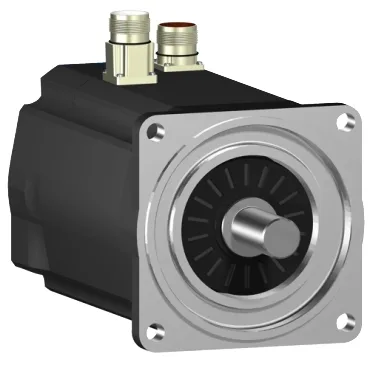
The SH31002P11A1200: This SH3 frame motor delivers 1900 W continuous power, but the torque you get at rated speed depends on the supply you feed it. At 400 V three-phase it makes 4.6 Nm at 4000 rpm; drop to 115 V single-phase and torque climbs to 5.5 Nm but speed caps at 1000 rpm. The peak stall torque is 18.3 Nm across the 115...480 V three-phase range — that's the number for sizing acceleration and emergency stops, not the continuous figure. The continuous stall torque is 5.8 Nm, and that's the holding torque at zero speed with natural convection cooling. No forced air needed — the motor sheds heat through the flange and housing, so panel airflow matters more than a dedicated fan.
Encoder and feedback — absolute single-turn SinCos Hiperface
The absolute single-turn SinCos Hiperface encoder gives position on power-up without a homing move — the drive reads the absolute position within one revolution. That saves a reference cycle on every power cycle, which matters on multi-axis machines where you don't want to re-home after a power dip. The torque constant is 1.21 Nm/A at 120 °C copper temperature. That's the hot value — the cold torque constant will be slightly higher because the magnets are stronger at ambient. Use the hot figure for worst-case drive current sizing. Back EMF constant is 77 V/krpm at 20 °C. Match this to the drive's DC bus voltage: at 4000 rpm the motor generates 308 V back EMF, leaving headroom for the drive to inject current above that voltage. If the bus is too low, the drive loses torque at high speed.
Mounting and environmental fit
Flange size is 100 mm (3.9 in) with a 95 mm centring collar and 9 mm mounting holes — standard international flange pattern. Overall length is 204.5 mm (8.05 in) from the mounting face to the rear of the housing. The shaft is 19 mm diameter with a parallel key, 40 mm shaft length, 6 mm key width. IP65 on the motor body and shaft bushing, IP67 on the housing — that's washdown-capable per IEC 60034-5. The rotatable right-angle connector or straight connector option lets you route the cable to clear adjacent hardware. No holding brake on this variant, so vertical-axis applications need an external brake or a counterbalance.
Drive tuning and electrical parameters
Stator resistance is 2.4 Ohm and inductance is 6.75 mH — those set the electrical time constant and the current-loop tuning gains. Maximum RMS current is 17.1 A, and the 3-second peak output current is the same 17.1 A, so the drive's peak current limit should match or exceed that. Four-pole motor, natural convection cooling. Maximum radial force at the shaft is 990 N at 1000 rpm, dropping to 620 N at 4000 rpm — bearing life is a function of both radial load and speed, so don't oversize the belt tension at high rpm. Maximum axial force is 160 N.