Power and speed profile across supply voltages
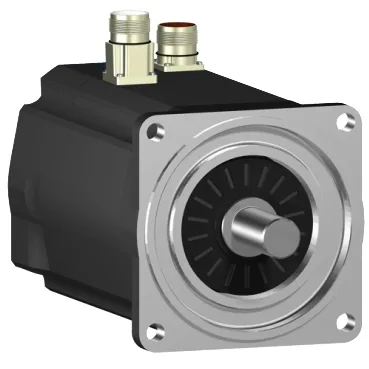
The SH31002P12F1200: This SH3 frame servo motor delivers nominal torque that shifts with the supply: 48.7 lbf.in (5.5 N.m) on 115 V single-phase, down to 38.9 lbf.in (4.4 N.m) on 480 V three-phase. The nominal speed climbs from 1000 rpm at 115 V single-phase to 4800 rpm at 480 V three-phase — so the same motor body covers a wide speed range depending on the drive and line voltage. Continuous power output follows the same pattern: 580 W on 115 V single-phase, 1090 W on 230 V single-phase, 1930 W on 400 V three-phase, and 2210 W on 480 V three-phase. The 1900 W continuous power rating is the headline figure for three-phase operation at nominal conditions.
Torque capability and brake for vertical loads
Peak stall torque reaches 162.0 lbf.in (18.3 N.m) across the 115-480 V three-phase range, with continuous stall torque at 51.3 lbf.in (5.8 N.m). The holding brake adds 79.7 lbf.in (9 N.m) of static holding torque — enough to secure a vertical-axis load without power, eliminating the need for an external brake resistor or mechanical lock. The absolute multiturn SinCos Hiperface encoder provides position feedback without a homing cycle after power loss — critical for applications where the axis must resume from the last commanded position. Combined with the brake, this motor is suited for Z-axis or gantry lifts where both position retention and restart accuracy matter.
Environmental protection and mounting
IP65 on the motor body and shaft bushing, IP67 on the housing — both conforming to IEC 60034-5. This means the motor withstands hose-down cleaning and dust ingress, making it suitable for food processing, packaging, or washdown zones. The rotatable right-angle connector and straight connector options let the cable exit adapt to tight cabinet layouts. Mounting uses an international standard flange with a 100 mm (3.9 in) flange size and 9.0 mm mounting holes. The centring collar depth is 3.5 mm (0.1 in) — confirm the mating pilot depth on the gearbox or machine frame to avoid axial interference.