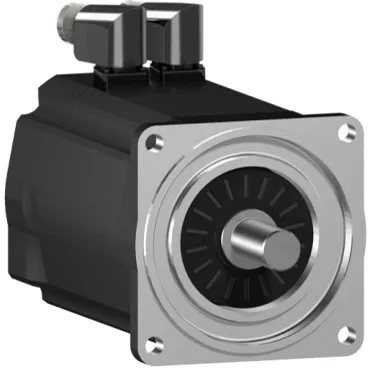
Motor form factor and what you bolt it to
The SH31002P12F2100 is a 100 mm flange-size servo motor with a 19 mm shaft diameter, parallel key, and a 40 mm shaft length — fits the standard IEC metric flange pattern for this power class. Overall length is 234.5 mm (9.2 in) including the encoder and brake housing; the centring collar depth is 3.5 mm. The rotatable right-angle connector lets you route the cable bundle in tight cabinet corners without a right-angle adapter.
Torque and speed across the supply range — the real envelope
This motor delivers different nominal torque depending on the supply: 5.5 N·m at 115 V single-phase, 5.2 N·m at 230 V single-phase, 4.6 N·m at 400 V three-phase, and 4.4 N·m at 480 V three-phase. The nominal speed also shifts — 1000 rpm at 115 V, 2000 rpm at 230 V, 4000 rpm at 400 V, and 4800 rpm at 480 V. Match your drive voltage to the speed-torque curve you actually need. Continuous power is 1900 W, but the nominal output power varies: 580 W on 115 V single-phase, 1090 W on 230 V, 1930 W on 400 V three-phase, and 2210 W on 480 V three-phase. The 17.1 A peak current (3 s) supports the 18.3 N·m peak stall torque for acceleration events.
Brake, encoder, and IP rating — what the holding torque and feedback mean for a Z-axis or vertical load
Feedback is an absolute multiturn SinCos Hiperface encoder — no homing sequence needed on power-up; the drive knows the shaft position immediately. The IP65 rating (motor body and shaft bushing per IEC 60034-5) means it handles washdown and airborne particulates in food, packaging, or woodworking environments.