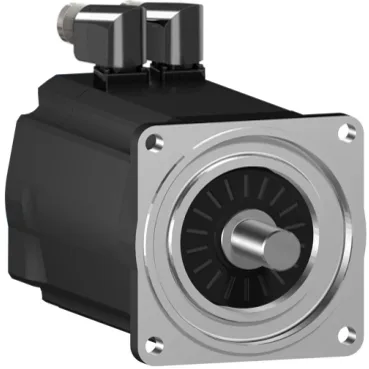
Flange size and mounting footprint
The SH31003M01A2100 uses a 100 mm (3.9 in) international standard flange with a 95 mm centring collar and 9 mm mounting holes. The centring collar depth is 3.5 mm, which locates the motor squarely on the machine frame before the bolts are torqued. Shaft diameter is 19 mm with a 40 mm shaft length and a 6 mm keyway. The smooth shaft end means no key is pre-installed; the key is fitted during coupling installation.
Speed, torque, and power across supply voltages
This motor delivers different speed-torque envelopes depending on the supply. At 400 V three-phase, nominal speed is 2000 rpm with 7 N.m torque and 1470 W output power. On 480 V three-phase, it reaches 2400 rpm at 6.76 N.m and 1700 W. On single-phase supplies, performance drops: 115 V yields 500 rpm at 7.8 N.m and 410 W; 230 V gives 1000 rpm at 7.5 N.m and 790 W. The continuous power rating of 1500 W is achievable only on three-phase supplies above 400 V.
Encoder feedback and electrical interface
The absolute single-turn SinCos Hiperface encoder provides position feedback without needing a homing cycle on power-up. The rotatable right-angled connector lets the cable exit direction be adjusted during installation, which helps in tight cable-tray routing. Stator resistance is 5.3 ohm and inductance is 17.4 mH. The torque constant is 2.35 N.m/A at 120 °C copper temperature, and the back EMF constant is 148 V/krpm at 20 °C. These values are needed for drive tuning and for estimating winding temperature from current feedback.
Thermal limits and cooling
Cooling is by natural convection only — no external fan or forced air. The continuous stall current is 3.4 A, and the peak current (3 s) is 14.7 A. The hot-spot copper temperature limit is 130 °C, so duty cycles that push sustained current above the continuous rating will require a cool-down period between cycles.
Environmental sealing and mechanical loads
Maximum radial force at the shaft is 1050 N at 1000 rpm, derating to 660 N at 4000 rpm. Maximum axial force is 160 N. These limits govern the coupling selection and the overhung load from a belt or gearbox.