Motor ratings across supply voltages
The SH31003M01A2200 delivers 1.5 kW continuous power from a 400 V three-phase supply, with nominal torque of 7 N.m at that voltage. On a 480 V three-phase line it produces 6.76 N.m at 2400 rpm, while single-phase 115 V and 230 V supplies yield lower torque and speed — 7.8 N.m at 500 rpm and 7.5 N.m at 1000 rpm respectively. The peak stall torque reaches 28.3 N.m across the 115–480 V three-phase range, which sets the acceleration ceiling for the driven load.
Feedback and environmental sealing
The absolute single-turn SinCos Hiperface encoder reports position on power-up without a homing cycle, which holds the unit on the grid for applications that cannot tolerate a reference move after a power loss. The IP65 rating on the motor body and shaft bushing, plus IP67 on the housing, means this motor withstands washdown environments — the sealing washer at the connector interface is the wet-end barrier, not the housing thread. Cooling is by natural convection only, so the motor relies on its own surface area and the mounting flange to dissipate heat. In a confined panel or high-ambient enclosure, the continuous torque must be derated below the 8 N.m figure to stay within the 130 °C copper hot-spot limit.
Mechanical interface and mounting
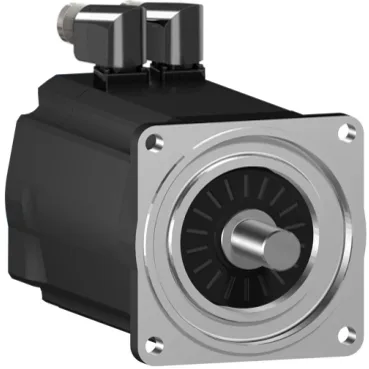
The motor uses an international standard flange with a 100 mm flange size and a 95 mm centring collar that locates the motor concentric to the load. The smooth shaft measures 19 mm diameter by 40 mm length with a 6 mm keyway — the absence of a holding brake means the load must be held by the servo drive's holding current or an external brake when power is removed. Maximum radial force at the shaft is 1050 N at 1000 rpm, dropping to 660 N at 4000 rpm — the bearing life follows the inverse cube of the radial load, so a belt-driven load applying 800 N at 2000 rpm (830 N limit) is acceptable, but the same load at 3000 rpm (730 N limit) would shorten bearing service life.