Torque and speed across supply voltages
The SH31003M01F1000: Nominal speed varies with the supply: 500 rpm at 115 V single phase, 1000 rpm at 230 V single phase, 2000 rpm at 400 V three phase, and 2400 rpm at 480 V three phase — the motor's performance is voltage-dependent, so the drive supply determines the base speed. Nominal torque also shifts with voltage: 7.8 Nm at 115 V single phase, 7.5 Nm at 230 V single phase, 7 Nm at 400 V three phase, and 6.76 Nm at 480 V three phase. Continuous stall torque is 8 Nm across the 115...480 V three-phase range, giving a consistent holding force at zero speed regardless of the supply variant. Peak stall torque reaches 28.3 Nm at 115...480 V three phase — this is the short-duration overload ceiling for acceleration or deceleration events.
Encoder, brake, and mechanical fit
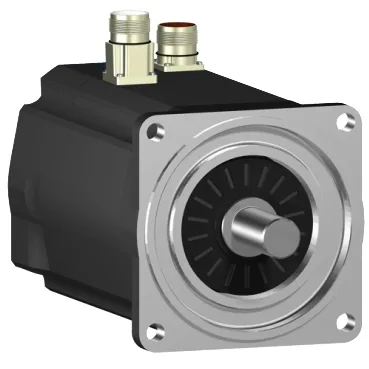
The absolute single-turn SinCos Hiperface encoder provides position feedback without a homing cycle on power-up — the single-turn resolution is sufficient for applications that do not require multi-revolution absolute position. The integrated holding brake delivers 9 Nm holding torque, enough to hold the load on a vertical axis when the drive is disabled. The motor flange is 100 mm (3.9 in) with an international standard flange pattern, centring collar diameter 95 mm (3.7 in), and four mounting holes on a 9.0 mm diameter — this matches the standard 100 mm frame size for direct mounting to a gearbox or machine frame. Shaft is 19 mm diameter, 40 mm length, smooth (no keyway) — the 6 mm key width is cut into the shaft, so a keyed pulley or coupling is required. Overall length is 271.5 mm (10.7 in) — this is the body length excluding the connector, so budget additional clearance for the straight connector and cable bend radius.
Thermal and mechanical limits for sizing
Cooling is by natural convection — no forced air or liquid cooling is required, but the motor must be mounted with adequate free air circulation around the housing to dissipate the 1500 W continuous power. Maximum radial force Fr is 1050 N at 1000 rpm, derating to 660 N at 4000 rpm — the bearing load capacity drops with speed, so a belt-drive or overhung load must be checked against the curve. Maximum axial force Fa is 160 N — this limits the thrust load from a helical gear or lead screw; exceeding it risks bearing damage. IP54 on the shaft bushing without the shaft seal ring, IP65 on the motor body and with the shaft seal ring fitted — the seal ring is required for washdown or dusty environments.
Electrical parameters for drive tuning
Stator resistance is 5.3 Ohm and stator inductance is 17.4 mH — these values are needed for the drive's auto-tuning routine to set current loop gains correctly. Torque constant Kt is 2.35 Nm/A at 120 °C copper temperature — this is the hot value; the cold Kt will be slightly higher, so the drive's thermal model should use the hot figure for continuous duty. Back EMF constant Ke is 148 V/krpm at 20 °C — this sets the voltage-speed ceiling; at 2400 rpm the back EMF is approximately 355 V line-to-line, which must stay below the drive's DC bus voltage. Maximum current Irms is 14.7 A — this is both the continuous current limit and the 3-second peak current rating, so the drive's current limit should be set to this value. The motor has 4 poles, so the electrical frequency at 2000 rpm is 66.7 Hz — the drive's carrier frequency and filter settings should accommodate this.