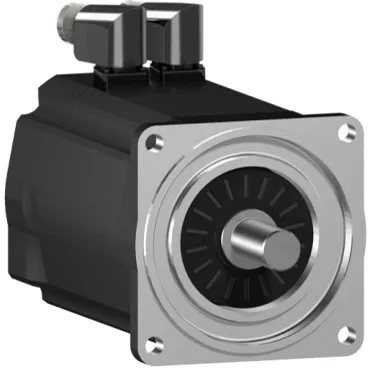
Motor sizing and speed range across supply voltages
The SH31003M01F2100 delivers nominal speed that depends on the supply: 500 rpm at 115 V single phase, 1000 rpm at 230 V single phase, 2000 rpm at 400 V three phase, and 2400 rpm at 480 V three phase. That means the same motor body covers a wide application range, but the drive and supply voltage must match the target speed — you cannot get 2400 rpm from a 115 V line. Nominal torque also shifts with voltage: 7.8 N.m at 115 V single phase, 7.5 N.m at 230 V single phase, 7 N.m at 400 V three phase, and 6.76 N.m at 480 V three phase. The continuous power rating is 1500 W, but the actual output power varies from 410 W at 115 V single phase up to 1700 W at 480 V three phase — so the 1500 W figure applies only at the design point, typically 400 V three phase. Peak stall torque is 28.3 N.m across the 115...480 V three-phase range, and continuous stall torque is 8 N.m. The holding brake adds 9 N.m of holding torque, which is enough to hold a vertical load at standstill without power to the motor windings.
Feedback and encoder integration
The encoder is an absolute single-turn SinCos Hiperface type. This means the drive gets absolute position within one revolution at power-up — no homing sequence needed for applications that don't require multi-turn tracking. The Hiperface protocol is standard across Schneider's Lexium drive family, so commissioning involves setting the encoder type in the drive parameter and letting the autotune cycle measure the motor's electrical data. The torque constant is 2.35 N.m/A at 120 °C copper temperature, and the back EMF constant is 148 V/krpm at 20 °C. These values are needed for the drive's current loop and velocity loop tuning — the drive's autotune routine typically measures them, but having the datasheet values lets you pre-load parameters if you're replacing a failed unit. Stator resistance is 5.3 Ohm and stator inductance is 17.4 mH. The 4-pole motor construction means the electrical frequency at 2000 rpm is 66.7 Hz — useful for setting the drive's pole count parameter correctly.
Mounting and environmental fit
The motor flange is 100 mm (3.9 in) with a centring collar diameter of 95 mm and depth of 3.5 mm. Mounting holes are 9 mm diameter on the standard international flange pattern. The shaft is 19 mm diameter, 40 mm long, smooth with a 6 mm keyway — so you need a coupling that accepts a 19 mm bore with a 6 mm key. IP65 rating on both the motor body and the shaft bushing means it handles washdown environments — the seal at the shaft exit is the weak point on many servo motors, and this one is rated to the same IP level as the housing. Natural convection cooling means no fan, so the motor relies on its surface area and the mounting flange for heat dissipation; derate if mounted in a confined space with restricted airflow. Maximum radial force depends on speed: 1050 N at 1000 rpm, dropping to 660 N at 4000 rpm. Maximum axial force is 160 N. These limits govern bearing life — overhung loads from belt drives or heavy couplings need to stay within the radial force curve at the operating speed.
Sourcing and lifecycle status
The part is packed singly, so order the quantity needed for the build plus a service spare if the application is critical.