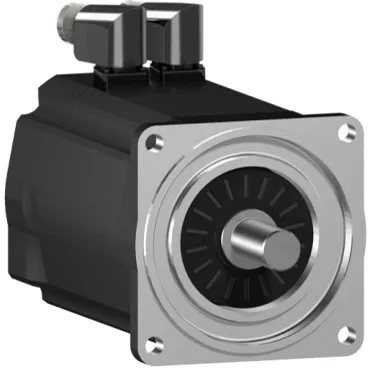
100 mm flange, 19 mm shaft — the frame that mates to standard gearboxes
The SH31003M02F2100 is a 100 mm (3.9 in) flange-size servo motor from Schneider Electric's SH3 series, with a 19 mm shaft diameter and 6 mm keyway — the same interface used across IEC-standard gearboxes and couplings, so the mechanical fit is predictable without a custom adapter plate. The holding brake delivers 9 N.m (79.7 lbf.in) of static torque, which holds a vertical load on a Z-axis without servo power — no external brake resistor or relay needed for the hold function, though the brake release must be wired through the drive's brake control output. IP65 protection on both the motor body and the shaft bushing means it withstands washdown in food, beverage, or wet machining environments — the shaft seal is the wet-end barrier, not just the housing gasket.
Speed and torque across the voltage range — the derating curve matters
Nominal speed climbs with supply voltage: 500 rpm at 115 V single-phase, 1000 rpm at 230 V single-phase, 2000 rpm at 400 V three-phase, and 2400 rpm at 480 V three-phase — the 4-pole winding sets the base speed, and the back EMF constant of 148 V/krpm at 20 °C limits how fast you can run before the drive bus voltage saturates. Nominal torque also derates with voltage: 7.8 N.m at 115 V, 7.5 N.m at 230 V, 7.0 N.m at 400 V, and 6.76 N.m at 480 V — the torque constant is 2.35 N.m/A at 120 °C copper temperature, so the current-limited torque drops as the drive's available voltage-to-frequency ratio falls. Peak stall torque is 28.3 N.m across the 115-480 V three-phase range, sustained for 3 seconds at 14.7 A — this is the acceleration ceiling for short moves; continuous stall torque is 8 N.m, set by the natural convection cooling and the 1500 W continuous power rating.
Absolute multiturn Hiperface — no homing after power loss
The absolute multiturn SinCos Hiperface encoder tracks position across power cycles without a battery — the multiturn count is maintained mechanically, so a machine that loses power mid-cycle does not need a re-home sequence on restart; the drive reads the absolute position directly. The rotatable right-angled connector lets the cable exit in any of four directions — useful when the motor sits in a tight cabinet corner where a straight connector would hit the enclosure wall.
Radial and axial load limits — bearing life constraint
Maximum radial force Fr drops with speed: 1050 N at 1000 rpm, 830 N at 2000 rpm, 730 N at 3000 rpm, and 660 N at 4000 rpm — a belt drive or pulley load must stay under these curves or the bearing life shortens; the 160 N maximum axial force limits direct thrust, so a helical-gear coupling is preferred over a spur gear that pushes axially. The smooth shaft end with 40 mm shaft length means the coupling or pulley clamps onto the full shaft diameter — no keyway extension beyond the key seat, so a plain-bore clamping coupling is the standard fit.