Motor ratings that shift with supply voltage
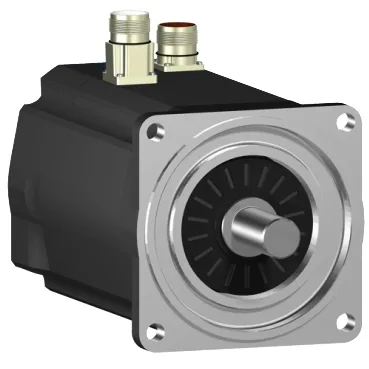
The SH31003M12F1000: This SH3 frame servo motor delivers a nominal speed that depends on the supply: 500 rpm at 115 V single-phase, 1000 rpm at 230 V single-phase, 2000 rpm at 400 V three-phase, and 2400 rpm at 480 V three-phase. Nominal torque also varies by voltage — 7.8 N·m at 115 V single-phase, 7.5 N·m at 230 V single-phase, 7 N·m at 400 V three-phase, and 6.76 N·m at 480 V three-phase. The continuous power rating is 1500 W, with peak stall torque reaching 28.3 N·m across the 115–480 V three-phase range. The holding brake delivers 9 N·m of holding torque, which matches the nominal torque range — important for vertical-axis applications where the load must stay put when power is removed.
Encoder and feedback — absolute multiturn SinCos Hiperface
The encoder is an absolute multiturn SinCos Hiperface type — this gives position feedback at power-up without a homing cycle, and the SinCos analog track provides fine interpolation for velocity control. The motor has 4 poles, and the back EMF constant is 148 V/krpm at 68 °F (20 °C). Stator inductance is 17.4 mH and stator resistance is 5.3 Ohm — these values matter for the drive tuning parameters (current loop gains) and for estimating the L/R time constant during commissioning.
Mounting and environmental fit
The motor uses an international standard flange with a 100 mm flange size and a 3.5 mm centring collar depth. The shaft is 19 mm diameter with a parallel key (6 mm key width) and 40 mm shaft length. Mounting holes are 9 mm diameter on a 95 mm centring collar diameter. IP protection is IP54 at the shaft bushing without a shaft seal ring, and IP65 for the motor body and with a shaft bushing — conforming to IEC 60034-5. This means the motor body handles washdown environments, but the shaft exit needs the seal ring for IP65 integrity. Cooling is natural convection — no external fan, so the thermal budget depends on the mounting surface and ambient airflow. Maximum radial force is 1050 N at 1000 rpm, derating to 660 N at 4000 rpm. Maximum axial force is 160 N. These limits govern the allowable belt tension or direct coupling load on the shaft.