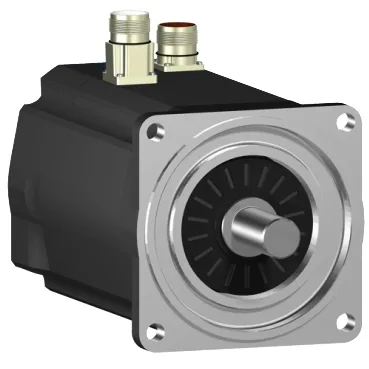
Three-phase supply and speed range — 1000 to 4800 rpm across voltage taps
The SH31003P01F1200 is a three-phase servo motor from Schneider Electric's SH3 series, designed for motion-control axes that need a holding brake and absolute position feedback without a homing cycle. It delivers 2400 W continuous power from a 100 mm flange, with nominal speed that varies by supply: 1000 rpm at 115 V single phase, 2000 rpm at 230 V single phase, 4000 rpm at 400 V three phase, and 4800 rpm at 480 V three phase. That speed spread means the same motor frame covers a low-speed high-torque spindle and a high-speed servo axis — the drive selection and transformer tap determine the actual output. The holding brake delivers 9 N.m (79.7 lbf.in) static holding torque, which holds a vertical-axis load at rest without the drive holding current. The absolute single-turn SinCos Hiperface encoder reports position on power-up — no reference run needed for single-turn applications, saving cycle time on indexing and pick-and-place stations.
Nominal torque is supply-dependent: 5.1 N.m at 480 V three phase, 7.5 N.m at 115 V single phase, 7 N.m at 230 V single phase, and 5.7 N.m at 400 V three phase. The peak stall torque is 28.3 N.m across the 115–480 V three-phase range — that is the short-term acceleration ceiling for rapid moves and load disturbances. Continuous stall torque is 8 N.m (70.8 lbf.in), so the motor can hold full stall current indefinitely without thermal trip.
Environmental sealing and mechanical interface
The motor carries IP65 on the motor body and shaft bushing, and IP67 on the housing (per IEC 60034-5) — the shaft bushing seal is the wet-end barrier, so washdown and coolant spray are handled as long as the connector is mated. Cooling is natural convection — no fan, so the thermal budget depends on the mounting surface and ambient airflow. The shaft is smooth, 19 mm diameter, 40 mm length — no keyway, so the coupling must use a clamping hub or shrink-fit method. The centring collar is 95 mm diameter with a 3.5 mm depth, and the flange is the international standard 100 mm. Maximum radial force is 1050 N at 1000 rpm, dropping to 660 N at 4000 rpm; maximum axial force is 160 N. These force limits govern overhung load and belt-drive sizing.
Electrical parameters and drive matching
Stator resistance is 1.43 Ω and stator inductance is 4.7 mH — these set the electrical time constant and the current-loop tuning gains. The torque constant is 1.22 N.m/A at 120 °C copper hot, and the back-EMF constant is 77 V/krpm at 20 °C. Maximum continuous current Irms is 28.3 A, with a 3-second peak of the same value — the drive's continuous current rating must match or exceed 28.3 A RMS. The motor has 4 poles, so electrical frequency at 4000 rpm is 133.3 Hz — the drive's carrier frequency and current-loop bandwidth must support this. The electrical connection is a straight connector — no right-angle option, so cable strain relief and bend radius must be managed in the cable track or chain.