Speed and torque across supply voltages
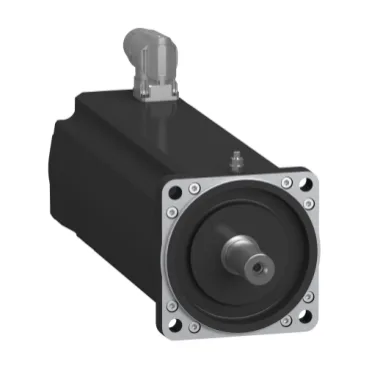
The SH31003P0BF4000: This SH3 frame servo delivers 4000 rpm nominal at 400 V three-phase supply, and can reach 4800 rpm on 480 V three-phase — useful for high-speed indexing or spindle applications where the machine cycle is limited by axis velocity. On 230 V single-phase the nominal speed drops to 2000 rpm, so the supply voltage at the cabinet dictates the usable speed range before any gearing. Nominal torque varies with supply: 7 N·m at 230 V single-phase, 5.7 N·m at 400 V three-phase, and 5.1 N·m at 480 V three-phase. The torque constant is 1.22 N·m/A measured at 120 °C copper temperature — the hot winding condition that governs continuous duty.
Holding brake and vertical-axis safety
For a machine tool or pick-and-place cell, the brake engages when the drive enable drops — the 9 N·m rating must exceed the reflected load torque at the motor shaft, including any overhung load from a timing-belt pulley.
Encoder feedback and position retention
The absolute multiturn Hiperface DSL encoder reports position on power-up without a homing cycle — critical for multi-axis coordinated motion where each axis must know its absolute position after a power cycle. The DSL protocol runs over a single cable pair, reducing cabling in the drag chain.
IP rating and shaft seal reality
The motor body is IP65 per IEC 60034-5, meaning it withstands hose-directed water and dust ingress. The shaft bushing without a shaft seal ring is only IP54 — if the application sees direct spray on the shaft exit (e.g., washdown zones), an optional shaft seal ring is needed to maintain the IP65 boundary at the bushing.
Peak and continuous torque capability
Peak stall torque is 28.3 N·m at 115–480 V three-phase, available for 3 seconds — this handles acceleration transients and emergency stops. Continuous stall torque is 8 N·m across the same voltage range, which sets the thermal limit for holding position under load without airflow. Continuous output power is 2400 W; nominal output power at 400 V three-phase is 2390 W — the motor runs near its continuous rating at the rated speed/torque point. Natural convection cooling means no fan noise or filter maintenance, but the thermal budget is fixed by the housing surface area.
Mechanical interface and mounting
The motor mounts on an international standard flange with a 100 mm flange size and 9.0 mm mounting holes. The smooth shaft is 19 mm diameter, 40 mm long, with a centring collar depth of 3.5 mm — standard for a direct coupling or timing-belt pulley with a keyless clamp. Overall length is 271.5 mm — check the available envelope in the machine frame, especially if the motor mounts vertically and the cable exit (straight connector or quicklock rotatable right-angled connector) must clear adjacent structure.
Electrical parameters for drive matching
Stator resistance is 1.43 Ω and inductance is 4.7 mH — these set the electrical time constant and influence the current-loop tuning on the servo drive. Back EMF constant is 77 V/krpm at 20 °C, which determines the bus voltage needed to reach rated speed against the motor's own voltage drop. Maximum RMS current is 28.3 A — the drive must be rated for at least this continuous current, and the peak current (also 28.3 A for 3 s) matches the drive's peak rating. The 4-pole motor runs at 2000–4800 rpm depending on supply; the drive's velocity loop bandwidth should be set for the pole count.
Radial and axial load limits
Maximum radial force at the shaft centre is 3570 N at 2000 rpm, dropping to 3120 N at 3000 rpm, and further to 130 N at 1000 rpm — the bearing life is inversely related to radial load, so a belt-driven load must be sized within these limits at the operating speed. Maximum axial force is 20 N, typical for a direct-coupled load with no thrust.