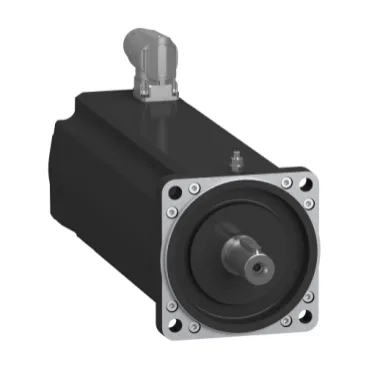
Motor performance across supply voltages
The SH31003P1BF4000 delivers 7 N·m nominal torque at 400 V three-phase and 5.1 N·m at 480 V three-phase; on single-phase 230 V it drops to 5.7 N·m. Nominal output power is 2390 W on both 400 V and 480 V three-phase supplies, versus 1470 W on 230 V single-phase. The continuous power rating of 2400 W sits close to the three-phase figures — this motor is designed for three-phase servo drives, not single-phase mains. Peak stall torque reaches 28.3 N·m across the 115...480 V three-phase range, with a corresponding peak current of 28.3 A. The drive must be sized for this peak current, not just the 7 N·m continuous torque, to avoid current-limit faults during acceleration or load transients.
Holding brake and encoder — what they mean for integration
The integrated holding brake holds 9 N·m and pulls in at 18 W. This brake holds the load at standstill — it is not a dynamic braking resistor. The drive must supply the brake release voltage; confirm the drive's brake output can handle the 18 W pull-in power and the inductive kickback when releasing. The quicklock rotatable right-angled connector on the motor side mates with a standard Hiperface DSL cable — no special tooling needed for the connector lock.
Mechanical fit — flange, shaft, and sealing
The 100 mm international standard flange (3.9 in) and 19 mm shaft with a 40 mm shaft length and 6 mm keyway match the common IEC servo mounting pattern. The centring collar depth is 3.5 mm — verify the mating pilot bore depth on the gearbox or machine frame. IP65 on the motor body with IP54 at the shaft bushing (without the shaft seal ring). For washdown environments, fit the optional shaft seal ring to bring the bushing to IP65. The straight connector and the quicklock connector are both rated for the motor's IP class when properly seated.
Lifecycle and sourcing
No official successor or direct cross-reference is recorded. The SH3 series (device short name SH3) covers this frame size; the sizing reference SH31003P confirms the motor variant. For a form-fit-function alternative, compare the flange size, shaft diameter, and encoder type against other SH3 order codes.