Speed-torque envelope across supply voltages
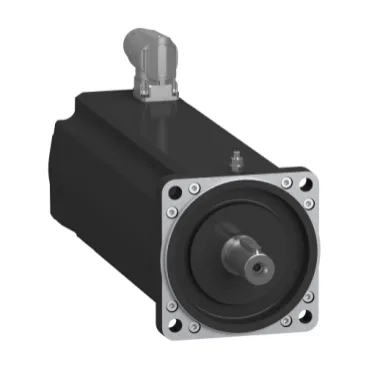
The SH31003P1BF4100: This SH3 frame servo delivers 4000 rpm nominal at 400 V three-phase input, 4800 rpm at 480 V three-phase, and 2000 rpm on 230 V single-phase supply. The nominal torque drops from 7 N·m at 230 V to 5.7 N·m at 400 V and 5.1 N·m at 480 V — the higher bus voltage trades torque for top speed. Continuous output power holds at 2390 W for both 400 V and 480 V three-phase, versus 1470 W on single-phase 230 V. Peak stall torque reaches 28.3 N·m across the 115–480 V three-phase range, with continuous stall torque at 8 N·m. The 3-second peak current limit of 28.3 A matches the maximum continuous Irms rating — the drive must be sized to supply this peak without dropping into current limit during acceleration or reversing moves.
Holding brake and vertical-axis safety
Integrated holding brake rated 9 N·m static torque, pull-in power 18 W. For Z-axis or inclined-axis applications, the brake holds the load at standstill without servo current — critical for safety during power loss or emergency stop. The brake engages when the motor is de-energized; the 18 W coil power must be factored into the control cabinet thermal budget and the DC bus sizing if a brake rectifier is used.
Absolute feedback and IP65 sealing
Absolute multiturn Hiperface DSL encoder — no homing sequence needed after power cycle; the motor knows its shaft position on boot. This saves cycle time on machines that power-cycle between batches. The IP65 rating (per IEC 60034-5) applies to both the motor body and the shaft bushing, making the unit suitable for washdown environments in food, beverage, or packaging lines where hose-directed cleaning is routine.
Electrical parameters for drive tuning
Stator resistance 1.43 Ω, inductance 9.4 mH, 4 poles. Torque constant 1.22 N·m/A at 120 °C copper temperature; back EMF constant 77 V/krpm at 20 °C. These values set the current-loop PI gains and the velocity-loop feed-forward terms in the servo drive. The natural convection cooling limits continuous duty — no external fan, so the mounting orientation and ambient air flow must be verified for sustained operation at rated torque.