Supply voltage dictates what this motor actually delivers
The SH31004P11A1100 is a three-phase servo motor, but its speed-torque curve shifts depending on what supply voltage the drive sees. At 400 V three-phase it hits 3000 rpm nominal with 7.9 N.m continuous torque; on 480 V three-phase it reaches 3600 rpm at 6.9 N.m. Run it on single-phase 115 V or 230 V and the nominal speed drops to 750 rpm or 1500 rpm respectively, with torque climbing to 9.9 N.m or 9.5 N.m. The continuous power rating is 2500 W — that's the thermal ceiling under natural convection cooling, no fan. The motor relies on the mounting surface and ambient airflow to shed heat, so a cramped cabinet or high ambient temperature will force derating below that figure. Stall torque is 10 N.m continuous across the full voltage range, with a peak of 40.5 N.m for short-term acceleration or breakaway loads. The 32.3 A peak current rating tells the drive what to budget for the current loop.
Encoder choice locks the drive family
The absolute single-turn SinCos Hiperface encoder means this motor only works with drives that support the Hiperface protocol — typically Schneider's Lexium series or third-party drives with a Hiperface option card. Single-turn gives position within one revolution; if the application needs multi-turn absolute position after a power cycle, this encoder won't deliver it. The torque constant is 1.62 N.m/A measured at 120 °C copper temperature — that's the hot winding value, not the cold start figure. The back EMF constant is 103 V/krpm at 20 °C, which affects the bus voltage headroom at high speed: a 400 V DC bus can run this motor to rated speed, but pushing above 3600 rpm on a 480 V line may hit the voltage limit. Stator inductance is 6.5 mH and resistance is 1.81 Ohm, giving an electrical time constant around 3.6 ms. That's within the tuning range of most modern servo drives, but the current-loop gains will need adjustment if swapping from a lower-inductance motor.
Mechanical fit — flange, shaft, and force limits
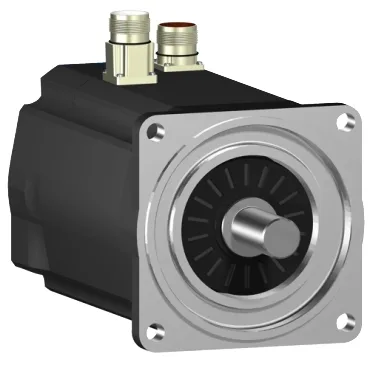
The motor uses a 100 mm IEC flange with a 95 mm centring collar and 9 mm mounting holes — standard dimensions that mate with most IEC-compliant gearboxes and machine frames. The shaft is 24 mm diameter with a parallel key, 50 mm shaft length, and 8 mm key width. Maximum radial force is 1070 N at 1000 rpm, derating to 740 N at 3000 rpm. Maximum axial force is 160 N — if the load applies thrust beyond that, an external bearing support is needed. No holding brake is fitted, so vertical-axis loads require either the drive's holding torque or an external brake.
Environmental rating and connection options
IP65 on both the motor body and the shaft bushing per IEC 60034-5 — the motor withstands hose-down and wet environments typical in food processing, packaging, or outdoor machine stations. The connector options include a rotatable right-angled connector and a straight connector, giving cable exit flexibility for tight enclosures. Natural convection cooling means no fan noise or fan maintenance, but the thermal budget is tighter than a fan-cooled motor of the same frame size. The 130 °C copper hot temperature indicates Class F insulation.
The sizing reference SH31004P ties to Schneider's drive sizing tools — useful for confirming the drive-motor pair before ordering. The motor ships individually, not in bulk packaging.