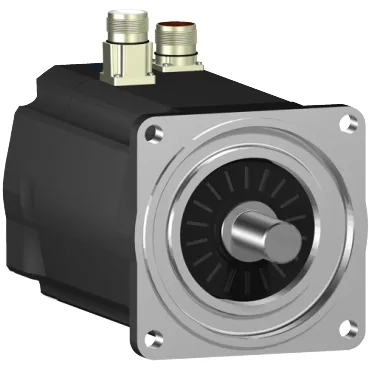
1700 W continuous, 11 Nm nominal — torque and speed across supply voltages
The SH31401M02F1000 delivers 1700 W continuous power with a nominal torque of 11 Nm at 400 V three-phase, dropping to 10.4 Nm at 480 V three-phase. On single-phase supplies, nominal torque holds near 10.95 Nm at 230 V and 10.6 Nm at 115 V, while nominal speed shifts from 1500 rpm (400 V) to 1800 rpm (480 V) and down to 375 rpm on 115 V single phase. The holding brake delivers 23 Nm holding torque — nearly double the nominal torque — which means this motor holds a vertical load securely at rest without back-driving through the gearbox. Peak stall torque reaches 27 Nm across the 115–480 V three-phase range, giving a 2.4× torque overload margin for acceleration through high-inertia loads.
Absolute multiturn Hiperface feedback — encoder type drives drive selection
The integrated absolute multiturn SinCos Hiperface encoder provides position feedback over multiple shaft revolutions without a home cycle — critical for applications like pick-and-place or gantry axes where the controller must know absolute position on power-up. This encoder type pairs natively with Schneider Electric Lexium servo drives and many third-party drives supporting Hiperface protocol. The torque constant of 2.78 Nm/A at 120 °C and back EMF constant of 193 V/krpm at 20 °C are the key parameters for drive tuning and current-loop setup.
IP54/IP65 sealing and mounting — panel integration notes
The motor carries IP54 protection at the shaft bushing without the shaft seal ring, and IP65 with the seal ring fitted — the IP65 configuration withstands washdown spray, making it suitable for food-and-beverage or wet machining environments. Mounting uses an international standard flange with a 140 mm flange size and 130 mm centring collar. The smooth shaft (24 mm diameter, 50 mm length) with 8 mm keyway accepts standard couplings and pulleys without special machining. Natural convection cooling means no external fan or compressed air is required — the motor relies on its own surface area and the machine frame for heat rejection, so mounting on a thermally conductive surface helps maintain continuous torque ratings.