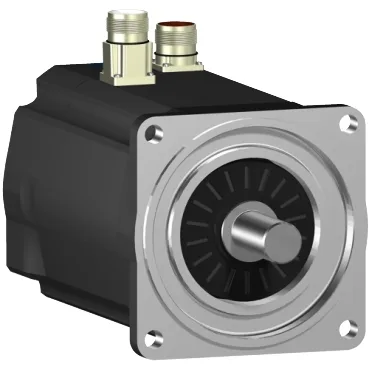
Supply-dependent speed and torque — sizing for the line voltage
The SH31401M12A1200: This SH3 series servo motor delivers different nominal speeds depending on the supply: 375 rpm on 115 V single-phase, 750 rpm on 230 V single-phase, 1500 rpm on 400 V three-phase, and 1800 rpm on 480 V three-phase. The nominal torque shifts accordingly — 11 N.m at 115 V single-phase down to 10.4 N.m at 480 V three-phase. That means the motor's performance envelope is tied directly to the available line voltage; the three-phase 400 V or 480 V connection gives the highest usable speed range for a given load. Continuous power is rated 1700 W, with peak stall torque of 27 N.m across the 115-480 V three-phase range. The continuous stall torque sits at 11.1 N.m, drawn at 4 A continuous stall current — a useful figure for sizing the drive's continuous current rating when the motor holds position under load.
Encoder choice and position feedback — no homing needed after power loss
The absolute multiturn SinCos Hiperface encoder retains position through power cycles. On a multi-axis machine where each axis must know its absolute position at power-up, this eliminates the homing sequence — the drive reads the position directly from the encoder on boot. The SinCos analog track gives high-resolution interpolation for smooth low-speed control. Back EMF constant is 193 V/krpm at 20 °C. At 4000 rpm maximum mechanical speed, the back EMF reaches about 772 V — well above a typical 400 V DC bus. The drive must be able to handle this voltage rise, or the usable speed range is limited by the DC bus voltage ceiling. The torque constant of 2.78 N.m/A at 120 °C gives the hot-running torque-per-amp figure for drive current loop tuning.
No holding brake — plan for external braking or drive-based holding
This variant ships without a holding brake. For vertical-axis applications or any load that must hold position at power-off, an external brake must be added — either a separate brake resistor and holding brake on the motor shaft, or a drive with a holding function that uses the motor's own torque. The continuous stall torque of 11.1 N.m at 4 A gives the drive enough current headroom to hold the load electrically, but that requires the drive to remain powered. Natural convection cooling means no fan noise and no fan maintenance, but the motor's thermal capacity is limited by its surface area and mounting plate. The copper hot-spot temperature is rated 130 °C — the drive's thermal model must protect against winding overtemperature during sustained overloads.
Mounting and environmental sealing — flange size and IP rating
IP65 on the motor body and shaft bushing, IP67 on the housing — conforming to IEC 60034-5. This means the motor withstands washdown and temporary immersion, suitable for food-and-beverage lines or wet machining environments. The straight electrical connector must be mated with a matching IP-rated cable assembly to maintain the seal.
Radial and axial load limits — bearing life planning
Maximum radial force Fr is 1930 N at 1000 rpm, derating to 1530 N at 2000 rpm and 1340 N at 3000 rpm. Maximum axial force Fa is 300 N. These limits define the bearing service life under direct-coupled loads; belt drives or overhung pulleys must stay within these envelopes to avoid premature bearing failure.