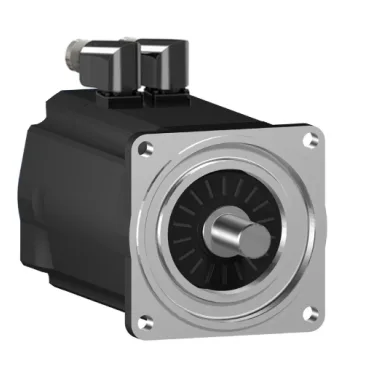
Supply voltage determines the speed and torque you get
The SH31401P02A2100: This motor's nominal speed shifts with the supply: 750 rpm on 115 V single-phase, 1500 rpm on 230 V single-phase, 3000 rpm on 400 V three-phase, and 3600 rpm on 480 V three-phase. The nominal torque follows the same pattern — 10.95 N.m at 115 V single-phase down to 8.4 N.m at 480 V three-phase. If your line runs 400 V three-phase, you get the full 2890 W nominal output power; on 115 V single-phase you're limited to 860 W. The continuous stall torque is 11.1 N.m across the 115-480 V three-phase range, and peak stall torque reaches 27 N.m for short-duration acceleration. The 7.8 A continuous stall current and 20.8 A peak current are the numbers your servo drive needs to be sized for.
Feedback and environmental sealing
The absolute multiturn SinCos Hiperface encoder gives the drive position at power-up without a homing move — critical for applications like gantries or rotary tables where the axis must know its location immediately after a power cycle. The IP65 rating on both the motor body and the shaft bushing means it withstands washdown environments; the O-ring at the connector face is the wet-end seal, not the housing thread.
Bearing load limits at speed
The maximum radial force on the shaft drops with speed: 1930 N at 1000 rpm, 1530 N at 2000 rpm, 1340 N at 3000 rpm. The maximum axial force is 300 N. These are the numbers for bearing life calculations — an overhung pulley or coupling that exceeds these at the operating speed will shorten bearing life.