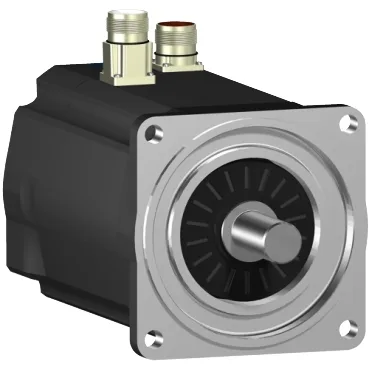
Motor dimensions and mounting — 140 mm flange, 272.5 mm body
The SH31402P11A1200 carries a 5.5 in (140 mm) international standard flange with a 5.1 in (130 mm) centring collar and 0.4 in (11 mm) mounting holes — this is the IEC frame size that bolts to a standard servo gearhead or machine base plate without adapter plates. Overall length is 10.7 in (272.5 mm) with a 0.9 in (24 mm) shaft diameter, 2.0 in (50 mm) shaft length, and a parallel key — the shaft end is keyed, so the coupling or pulley bore must match the 8 mm key width. The motor is naturally convection-cooled (no external fan), so the mounting surface acts as the primary heat sink — derate the continuous torque if bolted to a thermally insulating bracket.
Torque and speed across supply voltages — the voltage dependency matters
This SH3 motor delivers 164.6 lbf·in (18.6 N·m) nominal torque at 750 rpm on 115 V single-phase, 151.3 lbf·in (17.1 N·m) at 1500 rpm on 230 V single-phase, 108.9 lbf·in (12.3 N·m) at 3000 rpm on 400 V three-phase, and 85.9 lbf·in (9.7 N·m) at 3600 rpm on 480 V three-phase — the torque-speed envelope shifts with the input rail, so the drive's DC bus voltage sets the available shaft power. Continuous stall torque is 172.6 lbf·in (19.5 N·m) across the 115...480 V three-phase range — that's the holding torque at zero speed before thermal limits kick in. Peak stall torque hits 531.9 lbf·in (60.1 N·m) on three-phase supply — roughly 3× the continuous stall figure, available for acceleration transients within the 44.1 A peak current limit.
Encoder feedback and electrical data — absolute single-turn Hiperface
The motor ships with an absolute single-turn SinCos Hiperface encoder — this is a digital-plus-analog hybrid feedback protocol that carries position data over a serial link while the analog SinCos tracks fine interpolation; the drive must support Hiperface to read the absolute position on power-up. Stator resistance is 0.6 Ω and stator inductance is 3.855 mH — these values set the I²R heating floor and the current-loop bandwidth the drive needs to tune. Torque constant is 1.47 N·m/A at 248 °F (120 °C) hot copper — the motor produces 1.47 N·m per amp of RMS current once the windings reach thermal equilibrium. Back EMF constant is 101 V/krpm at 68 °F (20 °C) — at 3000 rpm the motor generates about 303 V line-to-line back EMF, which must stay below the drive's DC bus voltage to maintain current control.
Environmental protection and mechanical limits — IP65, radial and axial loads
IP65 on the motor body and shaft bushing per IEC 60034-5, with IP67 on the housing — the motor withstands washdown spray from any direction, but the straight connector (not angled) must be oriented to avoid pooling at the seal face. Maximum radial force Fr is 2240 N at 1000 rpm, dropping to 1550 N at 3000 rpm — the bearing life calculation uses this speed-dependent curve, not a single static figure. Maximum axial force Fa is 300 N — this is the thrust limit for direct-coupled loads; a belt drive that pulls axially will exceed it unless the pulley is located against a shoulder.