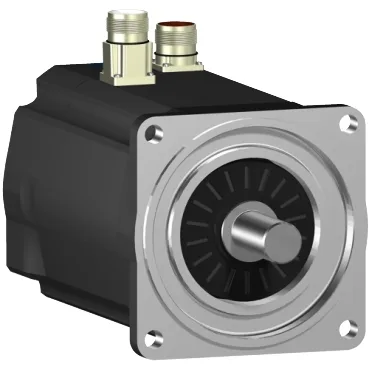
Torque and speed across supply voltages
The SH31402P12A1200: This SH3 motor delivers different torque and speed depending on the supply — at 400 V three-phase it produces 12.3 N.m nominal torque at 3000 rpm, while at 480 V three-phase that drops to 9.7 N.m at 3600 rpm. The nominal output power is 3860 W at 400 V and 3660 W at 480 V, so the motor is optimized for the 400 V line. Peak stall torque reaches 60.1 N.m across the 115...480 V three-phase range, giving a healthy overload margin for acceleration transients. Continuous stall torque is 19.5 N.m over the same voltage window.
Encoder and feedback for absolute position
The absolute multiturn SinCos Hiperface encoder retains position through power cycles — no homing routine needed after a restart. The SinCos analog tracks provide fine interpolation for low-speed smoothness, while the Hiperface protocol carries the multiturn count over the serial link. Back EMF constant is 101 V/krpm at 20 °C, which sets the voltage-speed limit for the drive — at 3000 rpm the back EMF is about 303 V, leaving headroom for current regulation on a 400 VDC bus.
Mounting, cooling, and environmental seals
The 140 mm international standard flange (IEC 60034-7) with a 5.1 in (130 mm) centring collar and 0.4 in (11 mm) mounting holes fits standard servo motor footprints. The shaft is 24 mm diameter with a parallel key, 50 mm shaft length. IP65 on the motor body and shaft bushing, IP67 on the housing — the motor withstands washdown spray but not submersion at the shaft seal. Natural convection cooling means no fan noise or filter maintenance, but the thermal budget depends on mounting surface and ambient airflow.
Electrical parameters for drive tuning
Stator resistance is 0.6 Ohm and inductance is 3.855 mH — these set the electrical time constant (~6.4 ms) and influence the current loop gains in the drive. Maximum continuous current is 44.1 A RMS, with the same value for 3-second peak, so the drive must supply that peak without saturation. Torque constant is 1.47 N.m/A at 120 °C copper temperature — derate from the cold value by about 8-10% as the winding heats to the 130 °C hot-spot limit.