Performance envelope across supply voltages
The SH31402P12F1200: This SH3-series servo motor delivers a nominal torque of 18.6 N·m at 115 V single-phase, 17.1 N·m at 230 V single-phase, 12.3 N·m at 400 V three-phase, and 9.7 N·m at 480 V three-phase — the torque drops as voltage rises because the motor's constant-power region shifts. The nominal speed follows the same pattern: 750 rpm at 115 V single-phase, 1500 rpm at 230 V single-phase, 3000 rpm at 400 V three-phase, and 3600 rpm at 480 V three-phase. For a three-phase 400 V supply, the nominal output power is 3860 W, and continuous power is 3900 W — the slight difference reflects the stall-torque thermal limit. Peak stall torque is 60.1 N·m across the 115...480 V three-phase range, with a continuous stall torque of 19.5 N·m. The holding brake adds 23 N·m of holding torque — enough to secure a vertical axis without external braking resistors. The torque constant is 1.47 N·m/A at 120 °C winding temperature, so the 44.1 A peak current (3 s rating) corresponds to the 60.1 N·m peak torque.
Mounting, sealing, and mechanical interface
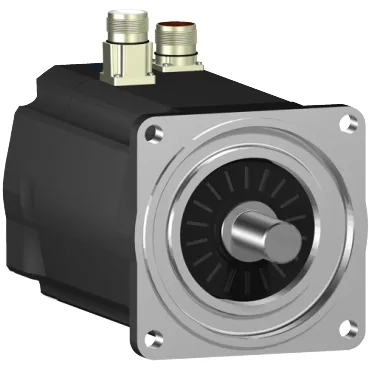
The motor flange is 140 mm (5.5 in) with an international standard pattern — four 11 mm mounting holes on a centring collar 3.5 mm deep. The shaft is 24 mm diameter by 50 mm long with a parallel key (8 mm key width). Overall length is 310.5 mm (12.2 in). The IP65 rating applies to the motor body and shaft bushing per IEC 60034-5; the housing is IP67 — suitable for washdown environments. Cooling is natural convection, so the motor relies on the mounting surface and ambient airflow for heat dissipation. Maximum radial force is 2240 N at 1000 rpm, 1780 N at 2000 rpm, and 1550 N at 3000 rpm — these limits guide belt-drive or overhung-load applications. Maximum axial force is 300 N. The straight connector electrical connection simplifies cable routing in tight panels.
Feedback and electrical parameters for drive tuning
The encoder is an absolute multiturn SinCos Hiperface type — no homing cycle needed after power loss; the drive reads the absolute position on startup. Stator resistance is 0.6 Ω, stator inductance is 3.855 mH, and the back EMF constant is 101 V/krpm at 20 °C. These values are needed for the drive's auto-tuning routine and for setting current-loop gains. The motor has 5 poles, which affects commutation and torque ripple.