Nominal speed and torque across supply voltages — the load-matching envelope
The SH31404P02A2000: This SH3 frame servo delivers 3000 rpm nominal at 400 V three-phase and 3600 rpm at 480 V three-phase, with the torque curve shifting accordingly: 12.9 N·m at 400 V, 11.1 N·m at 480 V. At single-phase supply, the speed drops to 750 rpm (115 V) or 1500 rpm (230 V), with torque rising to 30.2 N·m and 26.3 N·m respectively — the motor is wound for high torque at low voltage, not just high-speed three-phase operation. Continuous power at 400 V three-phase is 4040 W, with the peak stall torque reaching 131.9 N·m across the 115–480 V three-phase range — that short-term overload capability handles acceleration and emergency stops without oversizing the drive.
Feedback and environmental sealing — drive compatibility and washdown fit
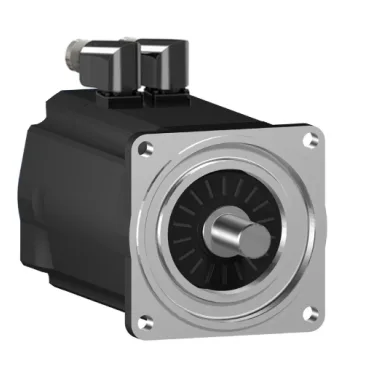
The absolute multiturn SinCos Hiperface encoder means the motor retains position on power loss without a battery backup — the drive must support Hiperface protocol; common Lexium and third-party servo drives with Hiperface input will pair directly. No homing sequence needed after a power cycle. IP54 on the shaft bushing without the seal ring, IP65 on the motor body and with the shaft seal ring installed. For washdown or dust-prone lines, specify the shaft seal ring — without it, the bushing is splash-resistant only. The rotatable right-angled connector lets the cable exit orient to the panel gland plate without a separate junction box.
Thermal and mechanical limits — natural convection, shaft loading, and mounting
Natural convection cooling means no fan noise or filter maintenance, but the motor relies on the mounting flange and ambient air for heat rejection — derate continuous torque if the panel ambient exceeds 40 °C or if the flange is on a non-metallic surface. The 140 mm flange with 130 mm centring collar and 11 mm mounting holes is the standard IEC B5 pattern; the 24 mm smooth shaft accepts a keyless clamp coupling or collet-style hub. Maximum radial force Fr is 2660 N at 1000 rpm, dropping to 1840 N at 3000 rpm — belt-driven loads must stay within this envelope or the bearing life shortens. Maximum axial force Fa is 300 N, typical for direct-coupled loads; thrust loads from helical gears or lead screws need a separate thrust bearing.
Electrical parameters for drive sizing — resistance, inductance, and current
Stator resistance is 0.28 Ω and inductance is 2.035 mH — the electrical time constant is about 7.3 ms, which sets the current-loop bandwidth ceiling for the servo drive. Continuous stall current is 21.3 A, with a 3-second peak of 95.6 A — the drive must supply that peak current for acceleration without tripping its own I²t limit. The torque constant is 1.57 N·m/A at 120 °C copper temperature, so the continuous stall torque of 33.4 N·m aligns with the 21.3 A continuous current. Back EMF constant is 104 V/krpm at 20 °C — at 3000 rpm the generated voltage is 312 V line-to-line, which stays within the 400 V DC bus headroom of a standard drive. The 5-pole motor has a lower cogging torque ripple than a 4-pole design, which matters for smooth velocity control at low speeds.
Lifecycle stage is current — Schneider continues to manufacture this SH3 frame motor; no end-of-life notice or last-time-buy window is open. The sizing reference SH31404P identifies the frame and winding variant for cross-referencing in Schneider's selection tools.