Speed range and torque across supply voltages
The SH31404P11F1200 delivers nominal speeds from 750 rpm on 115 V single-phase up to 3600 rpm on 480 V three-phase — the speed you get depends entirely on the supply you feed it. At 400 V three-phase, the motor runs 3000 rpm nominal, producing 4040 W continuous power. At 480 V three-phase, that climbs to 3600 rpm and 4190 W. Nominal torque varies with supply too: 30.2 N.m at 115 V single-phase, 12.9 N.m at 400 V three-phase, 11.1 N.m at 480 V three-phase. Peak stall torque hits 131.9 N.m across the 115–480 V three-phase range — that's the short-duration muscle for acceleration or overcoming load inertia.
Brake and encoder — what they mean for the application
Encoder is absolute single-turn SinCos Hiperface — provides position feedback on power-up without a homing cycle, essential for applications where the machine must resume from the last known position after a power loss. Single-turn limits absolute position to one revolution; multi-turn would require a different encoder option.
Environmental sealing and mounting
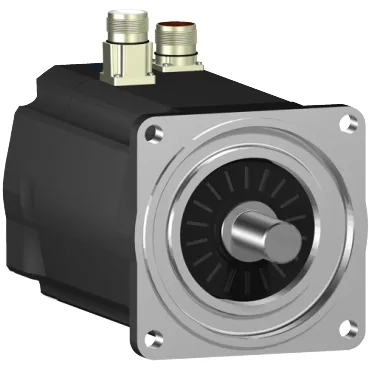
IP65 on the motor body and shaft bushing, IP67 on the housing per IEC 60034-5 — the motor withstands washdown and temporary immersion. That makes it suitable for food processing, packaging, or any line where hosedown cleaning is routine. Mounts on a 140 mm international standard flange (5.5 in) with a 24 mm shaft diameter and parallel key. Centring collar depth is 3.5 mm — the pilot register engages the mating flange before the bolts take the load. Cooling is natural convection; no fan or external blower required.
Electrical parameters for drive matching
Stator resistance is 0.28 Ohm, inductance 2.035 mH — these set the electrical time constant and influence the current-loop tuning on the servo drive. Torque constant is 1.57 N.m/A at 120 °C copper temperature; back EMF constant is 104 V/krpm at 20 °C. Maximum RMS current is 95.6 A, also the 3-second peak current rating. Maximum radial force Fr is 2660 N at 1000 rpm, derating to 1840 N at 3000 rpm — belt-driven loads must stay within these limits to avoid bearing overload. Maximum axial force Fa is 300 N.