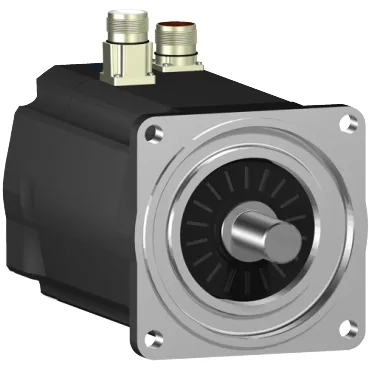
4 kW servo motor with holding brake — SH31404P12F1200
The SH31404P12F1200 is a Schneider Electric SH3 series servo motor with integrated holding brake, delivering 4.04 kW continuous power from a three-phase supply. It's built for applications that need position holding at standstill — the 36 N.m holding brake locks the shaft when power is removed, making it a natural fit for vertical-axis gantries, Z-axis stages, or any load that must not drift on power-down. Speed follows the supply voltage: 3000 rpm on a 400 V three-phase line, 3600 rpm at 480 V, and lower speeds on single-phase supplies (750 rpm at 115 V, 1500 rpm at 230 V). The nominal torque also shifts with voltage — 12.9 N.m at 400 V three-phase, 11.1 N.m at 480 V. Match the drive's DC-bus voltage to the motor's rated winding to get the torque curve you're expecting.
Torque and overload capability — what the numbers mean for sizing
Continuous stall torque is 33.4 N.m across the 115–480 V three-phase range — this is the torque the motor can hold indefinitely at standstill without overheating. The peak stall torque reaches 131.9 N.m, available for short acceleration bursts (typically 3 seconds). That 4:1 peak-to-continuous ratio gives headroom for rapid indexing or overcoming static friction on startup. The torque constant is 1.57 N.m/A at 120 °C copper temperature — this tells you the current required to produce a given torque. With a maximum RMS current of 95.6 A, the motor can deliver its peak torque within the thermal limit of the winding (rated for 130 °C hot-spot). Stator resistance is 0.28 ohm and inductance is 2.035 mH, which influences the drive's current-loop tuning and ripple current.
Feedback, sealing, and mechanical interface
The encoder is an absolute multiturn SinCos Hiperface type — it reports position at power-up without a homing cycle, which saves time on multi-axis machines that power-cycle between shifts. The straight connector exits the motor body, so plan cable routing accordingly; the motor is not designed for a right-angle or rotatable connector. IP65 on the motor body and shaft bushing, IP67 on the housing — this motor handles washdown and dust ingress per IEC 60034-5. Cooling is natural convection, so it relies on surface area and airflow; mounting it in a confined space or against a heat source will reduce the continuous torque available before the winding hits 130 °C. The 140 mm flange (IEC standard) with a 24 mm shaft and parallel key (8 mm key width, 50 mm shaft length) is a common interface for this power class. The centring collar depth is 3.5 mm. Maximum radial force at the shaft nose is 2660 N at 1000 rpm, derating to 1840 N at 3000 rpm — stay within these limits to avoid bearing overload.