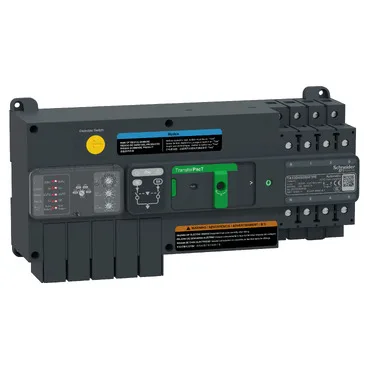
The Schneider Electric TA10D4S0504TPE is a TransferPacT automatic transfer switch (ATS) rated for 50 A continuous, 4 poles, on a 400 V AC 50/60 Hz network. It's a PC-class switch per IEC 60947-6-1, meaning it's designed for full-rated current switching between two power sources — typically utility and generator — without relying on separate contactors or circuit breakers to handle the load. The AC-33B utilization category covers mixed motor and resistive loads, so it's comfortable on a panel feeding pumps, lights, and HVAC controls. Rated uninterrupted duty means it can sit closed on the preferred source indefinitely — no derating for continuous carry. The rotary knob selector gives you both automatic and manual operating modes. In auto, the controller handles the transfer logic; in manual, you crank the knob to force the switch to either source or to the OFF position, which accepts a padlock for lockout/tagout. Three contact positions — Source 1, Source 2, and OFF — with mechanical interlocking between the two sources so they can never close together. That interlock is the safety backbone: no parallel feed, no backfeed risk during generator testing. The switch itself is rated for isolation (suitable for isolation per IEC 60947-6-1), so it doubles as a disconnecting means on the source side. Contact position indicator visible on the front face confirms which source is live — handy during commissioning when you're verifying phase rotation before closing the generator breaker.
The headline number is 50 A at 400 V AC, but the real selection gate is the AC-33B utilization category. That rating tells you the switch is tested for switching mixed loads — motors, resistive heaters, and lighting — not just pure resistive. If your downstream load is mostly motor (pumps, compressors, conveyors), AC-33B is the right call. Short-circuit performance: the switch alone can make 15 kA peak at 400 V, but with an upstream circuit breaker it handles 75 kA peak. That 75 kA figure is the coordinated peak making current — it means the ATS can close onto a fault and survive if the upstream breaker clears it. The short-time withstand (Icw) is 5 kA for 0.1 seconds, which is modest — this isn't a fully rated transfer switch for high-fault locations. Rated impulse withstand voltage is 6 kV for both the switch and the controller — standard for 400 V industrial gear. The controller electronics are rated for 500 V insulation voltage, while the switch power circuit is rated 800 V. That's a common split — the control side sees lower stress. The signal contacts come in three configurations (1 NO + 2 NC, 1 NC + 2 NO, or 2 NO) — you pick the one that matches your PLC input card or alarm panel. All screw-type connections, top and bottom, with an 18 mm pitch that matches standard DIN-rail terminal blocks for neat wiring.
The 310 mm width and 147 mm height require backpanel space. The 94 mm depth fits a standard enclosure.
What the deployment looks like
This ATS goes into a panel that needs automatic source transfer — typically a critical load fed by utility and a standby generator. The PC class means it can switch the full load current, so you don't need separate bypass contactors. The automatic/manual rotary knob gives the commissioning engineer a way to test the generator transfer without pulling the utility fuse.