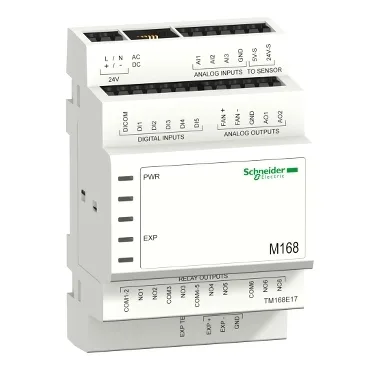
Is the TM168BEVCMEM still being made?
The module is the M168 electronic expansion-valve driver — an application-specific expansion module with expansion bus and Modbus port — so any replacement is a refrigerant-control fit, not a generic digital I/O swap.
What does the I/O map look like on a TM168BEVCMEM?
Three discrete inputs are split as two non-isolated and one isolated digital input at 100…240 V AC/DC, so high-voltage compressor line voltage can land on the isolated channel without back-feeding the low-voltage section. Two discrete outputs switch up to 250 V AC at 5 A — the level a refrigerant solenoid or EEV stepper driver expects for the actuator side. A 12 V AC/DC rail powers the connected sensor, so 4–20 mA transducers or Pt/NTC probes can be wired without an external supply.
Panel fit and electrical environment
Electrical durability is rated 100,000 cycles on both the 24 V AC and 24…37 V DC supply rails, which is the cycle budget an EEV valve actuator sees across years of duty.
Compliance mark and standards
The face carries the CE and UL marks and is qualified to EN 60730-1, EN 61000-6-1, EN 61000-6-3, and UL 60730 — the automatic electrical control standard used across HVAC/refrigeration controllers, plus the EMC immunity/emissions envelope.
Mechanical envelope
Footprint is 2.4 in (60 mm) deep by 2.8 in (71 mm) wide by 5.04 in (128 mm) tall, so the panel cutout and DIN-rail real estate match the standard M168 module width on the rack. Operating window is 14…140 °F (−10…60 °C) and storage is −13…140 °F (−25…60 °C) — a control-cabinet envelope, not a condensing environment. Up to 2000 m (6561.68 ft) operating altitude without derating, which covers the typical mechanical-room and rooftop plant installation.