What the ratings mean in the field
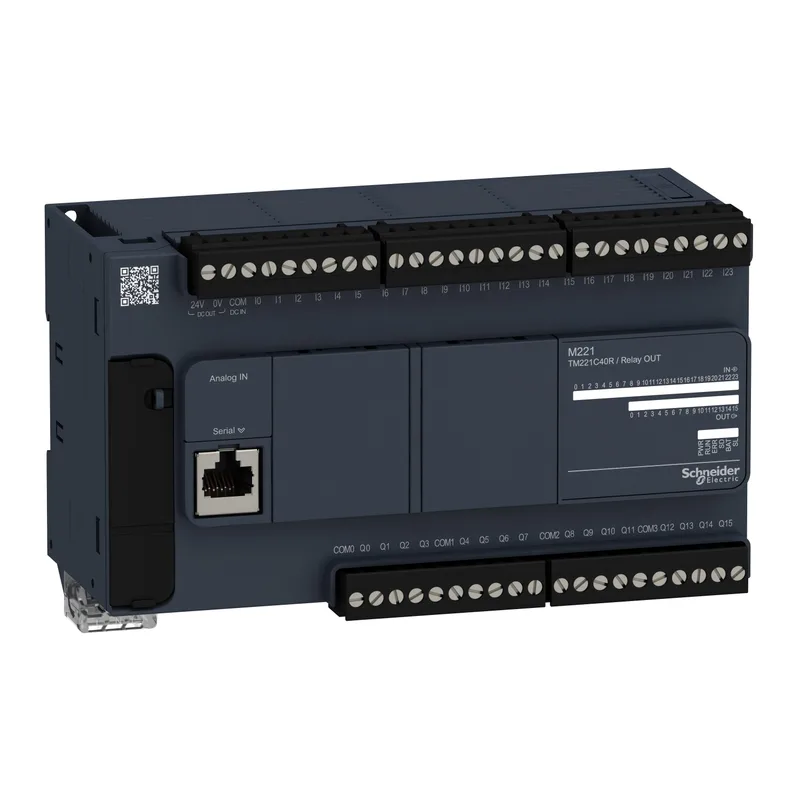
The TM221C40R: Relay outputs carry a minimum load of 1 mA at 5 V DC — that's the spec that matters when you're switching small signal relays or pilot lights. Switches up to 20 times per minute at max load, so it'll handle a contactor cycling for a conveyor but not a high-speed pick-and-place. Fast inputs I0, I1, I6, I7 turn off in 35 µs and turn on in 5 µs. That's enough for single-phase pulse counting or encoder feedback on a slow axis. If you need high-speed counting, this controller also handles A/B quadrature with the same fast inputs. The 24 V DC sensor supply gives you 250 mA to power proximity sensors or photo-eyes directly from the controller — one less power supply to lug around. Isolation between logic and outputs is 2300 V AC; between supply and ground is 1500 V AC. That's solid for most industrial environments without active grounding schemes.
Built-in regulation and backup
Backup goes to built-in flash memory (256 kB for app and data), so a battery failure doesn't lose the program. The battery just keeps the clock and volatile variables. On the van I'd carry a spare BR2032 or CR2032X; they're common coin cells.
Compliance and paperwork
Stamped CE, listed to UL 508, CSA C22.2 No. 213, and IEC 61131-2. Also carries IACS and ANSI/ISA 12-12-01 for hazardous location use — Class I Division 2 groups A,B,C,D. If your FAT or site acceptance needs a declaration, the standards are all published; the CE marking covers RoHS and REACH by self-declaration under the Low Voltage Directive. Pollution degree 2 — normal factory floor, not conductive dust or wet environments. Operating altitude to 2000 m, storage to 3000 m. That covers most installations outside high-altitude mining or pressurised chambers.
Sourcing note
This part is active and widely stocked. Submit an RFQ with your quantity and target lead time; we'll quote against the Schneider distributor network. No obsolete scavenging or cross-reference guesswork.