Communication and performance
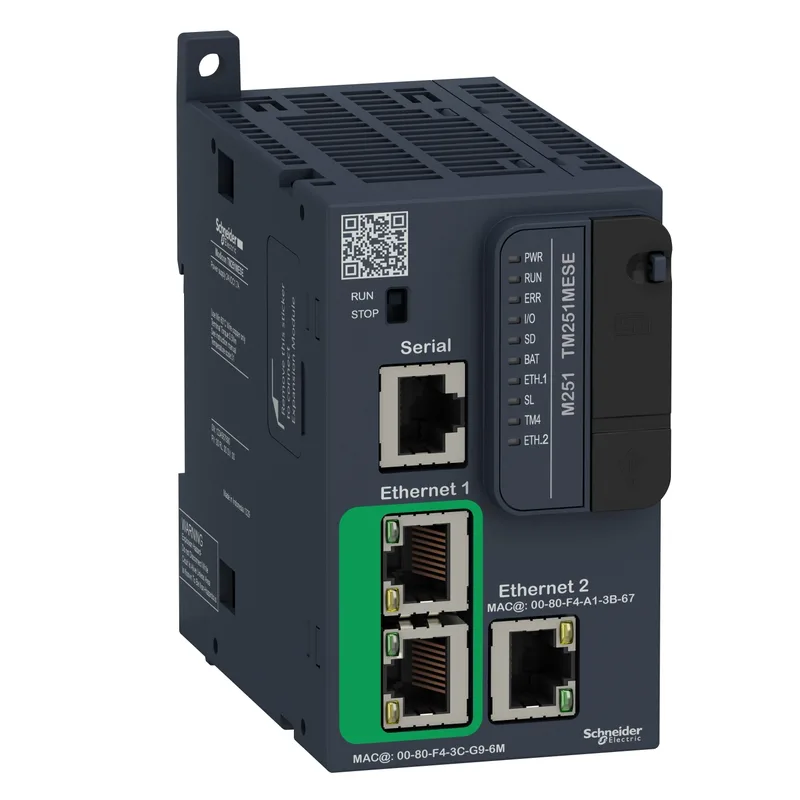
Dual Ethernet ports handle 10BASE-T/100BASE-TX, each with its own IP stack. That means one port can run a machine-level EtherNet/IP scanner while the second talks to a plant-wide Modbus TCP network — or serve as a web server via the embedded WebVisu. Cycle times: expect 10 ms for 16 EtherNet/IP connections, 64 ms for 64 Modbus TCP devices. For serial legacy gear, there's an RS485 port (15 m at 115.2 kbit/s) and an RS232 (3 m). USB is there for local programming at 480 Mbit/s. Memory-wise, the TM251MESE has 64 MB of system RAM and 128 MB of built-in flash for user program backup — no SD card required for basic retention. The real-time clock runs off a BR2032 lithium battery, which keeps the time for up to two years at 25 °C. Clock drift is under 60 seconds per month at that temperature, so scheduled events stay on track. An optional SD card (up to 16 GB) can hold extra logs or recipes.
Environment and isolation
Rated for pollution degree 2 environments — typical for dry, non-conductive dust conditions inside an enclosure. It handles 15 gn shock for 11 ms and vibration as per IEC 60068-2-6: 3.5 mm amplitude up to 8.4 Hz, then 3 gn up to 150 Hz. Operating altitude goes to 2000 m; storage altitude to 3000 m. Humidity tolerance is 10–95% non-condensing across operation and storage. Isolation between supply and ground is a single 500 V AC barrier — non-isolated between supply and internal logic. That's typical for PLCs in this class; just ensure the external 24 VDC supply is properly grounded and filtered to avoid ground loops.