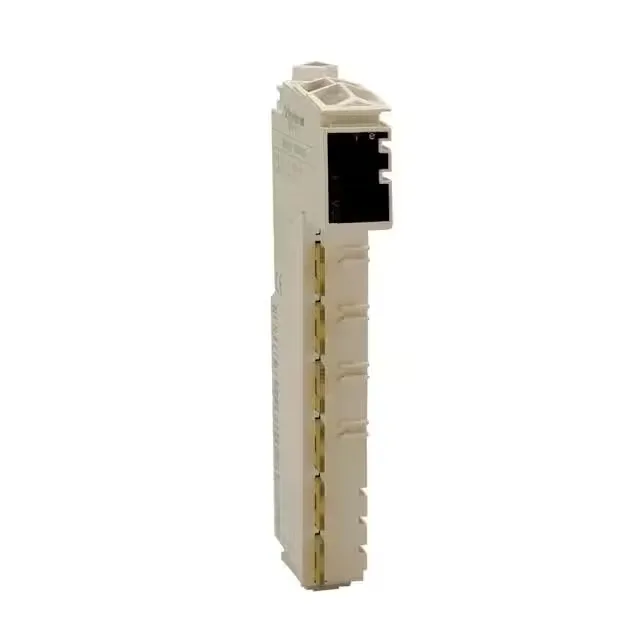
The TM5SAI2PH is active in production.
Channel-to-bus isolation is 500 Vrms AC. Common-mode rejection exceeds 95 dB. Temperature coefficient is 0.004 %FS/°C. Measurement resolution is 0.1 °C. The module is certified to UL 508, CSA C22.2 No. 142 and 213, and IEC 61131-2. Pollution degree 2 and shock resistance 15 gn / 11 ms qualify it for standard industrial panels, not for extreme vibration environments.
Where this module fits in a TM5 station
Mounts on a DIN rail within a TM5 bus base. Width is 12.5 mm. Internal supply via backplane bus powers the module and two sensor loops. Front-panel LEDs: green for power supply, red for power fault, two green per input channel. Shielded cable is required for the sensor connections, and the IP20 housing suits installation inside a closed cabinet.
How it relates to the 4-channel TM5SAI4PH
The TM5SAI4PH is the 4-channel sibling with the same input type (Pt100/Pt1000), same dimensions (12.5 mm × 75 mm × 99 mm), same 16-bit resolution, and identical temperature range. The key difference is channel count: two versus four. The measurement error and non-linearity specs are identical within the same tolerance band. Panel fill factor differs – you need one TM5SAI4PH to cover four probes instead of two TM5SAI2PH modules. The 4-channel version draws the same 46 mA from the 24 V DC supply and dissipates the same 1.11 W. If your BOM specifies two RTD inputs and you later need four, the TM5SAI4PH is a parametric peer that shares the same form, wiring style, and software configuration – not a second source, but a direct alternative within the same catalog generation.