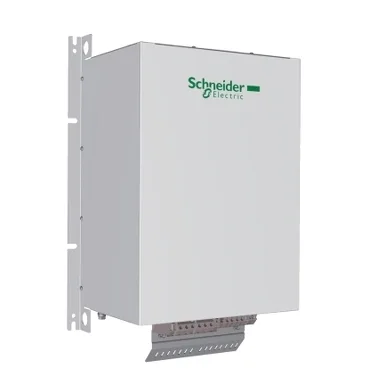
The Schneider Electric VW3A46163 is a passive filter designed to reduce current harmonics on Altivar variable speed drives. It's a line-side filter, not a dV/dt or sine-wave output filter — its job is to bring the drive's input current distortion down to levels that keep the installation within IEC 61000-3-12, IEC 61000-3-2, IEC 61000-3-4, IEC 61000-2-4, and G5/4 engineering recommendation limits. The THDI figure depends on which Altivar it's paired with. On ATV61H, ATV71H, and ATV71W drives at 18.5 kW / 25 hp, it delivers 10 % THDI. On ATV61W, ATV650, ATV630, ATV950, and ATV930 drives at the same power, it achieves 5 % THDI. That's the difference between meeting a general industrial harmonic limit and a more stringent one. Rated for 31 A input and 32 A output at 480 V +/- 10 %, 60 Hz +/- 2 %, three-phase. Efficiency is 98 %, with 335 W thermal losses to vent from the enclosure.
One filter per drive for the listed Altivar models — ATV61H, ATV71H, ATV71W, ATV61W, ATV650, ATV630, ATV950, and ATV930, all at the 18.5 kW / 25 hp rating. It's sized for a single drive, not a shared bus. IP20 base rating, IP55 when enclosure-mounted. That means it's fine inside a ventilated panel; if it's going into a washdown area, the enclosure needs to carry the IP55 rating. Operating temperature is 5...45 °C without derating, and 45...60 °C with 3 % per °C derating. Above 1000 m altitude, derate 5 % per additional 1000 m. Electrical connection uses A/B terminals accepting 2.5 mm², plus X1-1...X2-3 terminals accepting 1.5...25 mm². Vibration resistance per IEC 60068-2-6: 2 mm peak-to-peak at 5...13.2 Hz, 0.7 gn at 13.2...150 Hz.
Power factor and harmonic performance
The filter also improves input power factor. At 150 % of line current, cos φ is 1.0. At 100 % of line current, cos φ is 0.99. At 75 % of line current, cos φ is 0.85. That means at typical operating points the drive sees near-unity displacement power factor, reducing reactive current draw from the supply. The filter can handle 1.5 x nominal current for 60 seconds — useful for short-duration overloads during acceleration or load transients.
This is a current-production part, not a last-time-buy or end-of-life item.