Headline ratings and what they drive
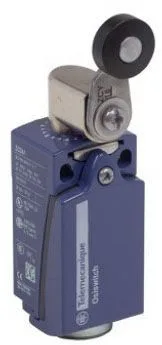
The Schneider Electric XCKD6118G11 is an Osiswitch compact-format limit switch in the XCKD family, sized for panel-edge and machine-guard position feedback rather than heavy-duty foundry duty. Its snap-action 1NO-1NC contact block drives a single safety/control circuit — the snap mechanism delivers positive opening on cam over-travel, which is what most machine-safety standards look for at a guard interlock. Contact rating is the headline: 240 VAC at 10 A and 250 VDC at 0.27 A. At 240 VAC the 10 A figure covers standard inductive motor loads and solenoid coils used on packaging lines; the 0.27 A DC limit is the more honest figure for any 24 VDC PLC-input tap, which is well under 1 A continuous. Operate the snap contact at or below the rated duty — exceeding it is the classic way these ZAMAK-body switches fail at the contact weld.
Enclosure, approvals, and where it sits on the line
Enclosure rating is NEMA 1/2/4/6/12/13 with IP66 and IP67, which means the housing tolerates indoor hose-down, outdoor drip, and dust-laden areas but is not rated for prolonged submersion. It is approved to UL and CSA, and the family is built against EN/IEC 60204-1 and EN/IEC 60947-5-1 — those are the standards machine builders cite when a guard switch drops into a CE-marked panel. The ZAMAK die-cast metal body is the Osiswitch XCKD tell — it shrugs off the mechanical knocks of a conveyor-side mount better than a plastic-bodied limit switch from the same price tier. Operating temperature span is -13 to 158 °F (-25 to +70 °C), so unheated warehouses and most process-area enclosures are in range; chilled-cold storage below -25 °C is not.
Wiring and actuator details a wireman asks about
Connection is through a PG11 cable gland feeding screw-clamp terminals — straightforward for a panel-side wireman routing a 2- or 3-conductor cable; not a quick-disconnect M12 form factor, so this switch is targeted at fixed wiring rather than modular cordset harnesses. The actuator head is a thermoplastic roller lever — the roller keeps the part from deflecting on a passing cam, extending mechanical life where the lever would otherwise slap. Snap-action operation means the contact transitions sharply regardless of cam approach speed, so the switch can be hit by a slow-moving guard edge and still toggle cleanly downstream.