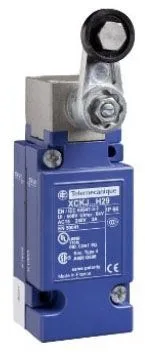
Rotary head limit switch for position detection in washdown zones
The XCKJ110511H7 is a heavy-duty limit switch from the OsiSense XC series, built with a rotary head and a spring-return roller lever actuator. It's the part you spec when a machine position needs to be confirmed in an environment that sees hose-down cleaning — the IP66 and NEMA 4/12 enclosure keeps water jets and dust out of the switching chamber. The 1 C/O (form C) contact configuration is the standard for limit switch feedback — one normally-open and one normally-closed set gives you both a safe-state signal and a position-confirm signal from a single device.
Electrical ratings — what the AC-15 and DC-13 numbers mean for your load
The switch is rated 3 A at 240 V in AC-15 duty (inductive load, typical for contactor coils and solenoid valves) and 0.27 A at 250 V in DC-13 duty (DC inductive load, like brake solenoids or DC relay coils). The AC-15 rating follows IEC 60947-5-1 Appendix A, which defines the make/break capability for pilot-duty loads — it's not a general-purpose resistive rating, so don't use the 10 A thermal current figure for switching motors directly. The 10 A thermal current (Ith) is the continuous current the contacts can carry when closed — it's the wiring and terminal rating, not the switching capacity. For switching duty, stay within the AC-15 or DC-13 envelope. The DC-13 endurance is verified at 5 million cycles at 24 V, 10 W inductive load, which is a realistic life figure for a machine that cycles a few times per minute over several years.
Mounting and wiring — body-mount with screw-clamp terminals
The switch mounts by the body — bolt it directly to the machine frame or a bracket using the 36 mm x 43 mm x 84 mm footprint. The screw-clamp terminals accept one 0.75 mm² to two 1.5 mm² conductors, which covers the standard control wiring gauge for limit switch circuits. The metal plug-in body means the switch head and contact block are replaceable without pulling the whole assembly off the machine — useful when the actuator gets bent but the wiring and mounting stay put.
Lifecycle and sourcing — still a current-production part
Sourced to order against your BOM quantity.