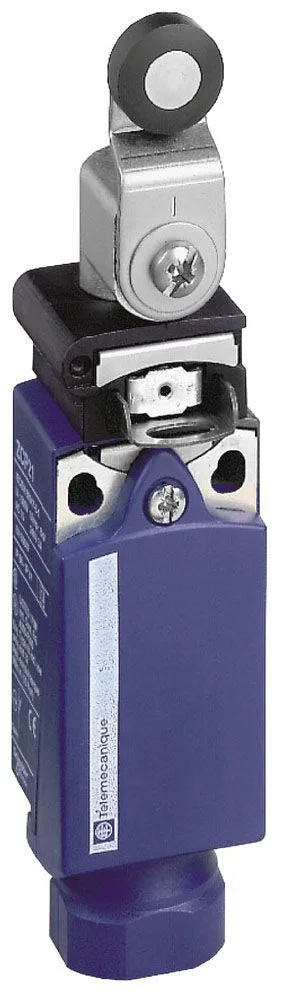
What the catalog says about XCPR2518P20
The Schneider Electric XCPR2518P20 sits in the limit-switch family under the Square D Sensors & Safety line, classed as a medium-duty limit switch. Lifecycle stage is listed as current, so the order code is still being produced rather than carried only through surplus inventory. The catalog entry carries the Telemecanique product name and a UPC of 389110210722. Where it lives in the field: medium-duty limit switches get used on moving-machine position feedback — guard-door interlock contacts, conveyor end-of-travel, or actuator-position sensing — where a mechanical actuator drives a snap-action block. The 'medium-duty' tag is the buyer's first sizing filter: heavier industrial switches take the same role on larger machinery; lighter microswitch-format parts handle panel-internal logic.
Sourcing posture and what to put on the RFQ
Independent distribution handles current Schneider Electric codes without the lead-time penalty of a factory-direct MOQ, and price breaks against the BOM quantity are confirmed at quote time. Procurement checklist for the PO: confirm the UPC 389110210722 matches the line on the quote, since limit-switch SKUs in the Telemecanique line often share a body style across multiple contact configurations. If a previously installed unit is being swapped, capture the actuator type and contact block from the nameplate before placing the order — the catalog description here does not pin a specific actuator head or contact arrangement, and the order code alone does not carry that detail.
Functional peers and whether they slot in
The closest catalog neighbors on file are proximity and photoelectric devices rather than mechanical limit switches — XS9E111A2L2 and XS4P30AB9D2 are inductive sensors, and XUK0AKSAL10 is a photoelectric sensor. That matters for sourcing reality: none of those peers are drop-in replacements for a medium-duty mechanical limit switch, because the sensing principle is different — an inductive sensor detects a metal target without contact, where a limit switch needs a mechanical cam or actuator to physically trip the contacts. Substituting one for the other requires both a wiring change and a re-evaluation of the safety-circuit category, since mechanical limit switches and proximity sensors carry different failure-mode behavior under IEC 60947-5-1 type 1 vs type 2 definitions.