What the 2.5 mm flush sensing range means for your target
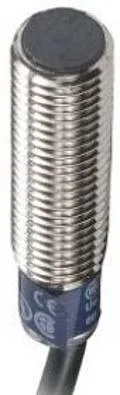
The XS108B3NAL2 is an 8 mm diameter tubular inductive proximity sensor from the Schneider Electric OsiSense XS family, with a 2.5 mm nominal sensing distance in flush mounting. Flush mount means the sensing face sits coplanar with the mounting surface — the sensor detects metal targets approaching axially, not from the side. The 2.5 mm range is the distance at which a standard mild steel target (1 mm thick, square, sized to 3× the sensing distance) triggers the output. For stainless steel or aluminum targets, derate the range by the material correction factor — typically 0.6× for stainless, 0.4× for aluminum — so a stainless target may need to be within 1.5 mm to reliably switch.
Output wiring and load drive — NPN NO at 200 mA
The output is NPN normally-open. When a target enters the sensing field, the output transistor switches to ground, sinking up to 200 mA from the load. This is a standard three-wire DC sensor: brown to +12-24 VDC, blue to 0 VDC, black to the PLC input or relay coil. The 200 mA capacity drives most PLC digital inputs directly and can switch a small DC relay coil without an interposing amplifier. The 2500 Hz switching frequency means the sensor can detect targets passing at up to 2500 events per second — suitable for moderate-speed counting on a conveyor or spindle, but not for high-speed cam or encoder applications above that rate.
Physical envelope and environmental sealing
The 8 mm barrel diameter with nickel-plated brass body and PPS sensing face is threaded for mounting in a standard M8 x 1.0 tapped hole or with a through-hole and locknuts. The 2 m PVC cable with three conductors exits the rear — no connector, so plan for a cable gland or junction box at the sensor end. IP65/67 means the sensor is protected against dust ingress and temporary immersion (1 m depth, 30 minutes). This suits washdown zones in food processing, packaging lines, and outdoor conveyor systems where hose-down cleaning is routine. Operating temperature range is -13 to 158 °F (-25 to 70 °C), covering most indoor industrial environments.