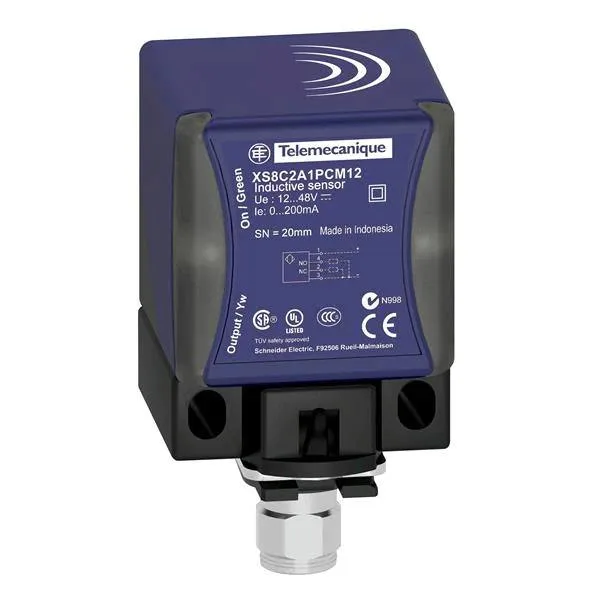
The Telemecanique XS8C2A1CAM12 is an inductive proximity sensor from the XS series, designed as a flat 40 x 40 x 70 mm fixed-body unit with a 5-position turret head for flexible detection orientation. It delivers a nominal sensing distance of 2 cm (flush mountable) and operates on a 2-wire DC supply from 10 to 58 VDC, outputting a discrete 1 NO signal. The M12 4-pin connector simplifies field wiring, and the PBT housing with IP67/IP69K ratings means it withstands high-pressure washdown environments common in food and beverage lines.
The 2 cm nominal sensing distance (Sn) is the rated detection range for a standard mild steel target; flush mounting means the sensor face can be level with the mounting surface without derating, which is critical for space-constrained tooling or cylinder-position sensing. The 2-wire DC output simplifies wiring (two wires for power and signal) but limits the switching capacity to 1.5 to 100 mA with overload and short-circuit protection — this is a low-current signal to a PLC input, not a direct load driver. The 300 Hz switching frequency is adequate for moderate-speed part detection (e.g., up to 300 parts per second on a conveyor), but not for high-speed cam or encoder applications. The 5-position turret head allows the detection face to be oriented in any of five directions without rotating the entire body, saving panel space and reducing bracket complexity.
Integration notes
The flat form factor (40 x 40 x 70 mm) and M12 connector make this a drop-in replacement for many existing 40 mm square inductive sensors. The 2-wire DC circuit means polarity must be observed (reverse polarity protection is built in), but the voltage drop at closed state is <= 4.2 V, so ensure the PLC input threshold can accommodate that drop. Response delay is 1.2 ms, recovery delay 1.8 ms, and first-up delay 7.5 ms — these are fast enough for most discrete part detection but not for high-speed counting above 300 Hz. The PBT front material resists mild chemicals and abrasion, but for aggressive cutting fluids or solvents, verify compatibility with the specific coolant chemistry.