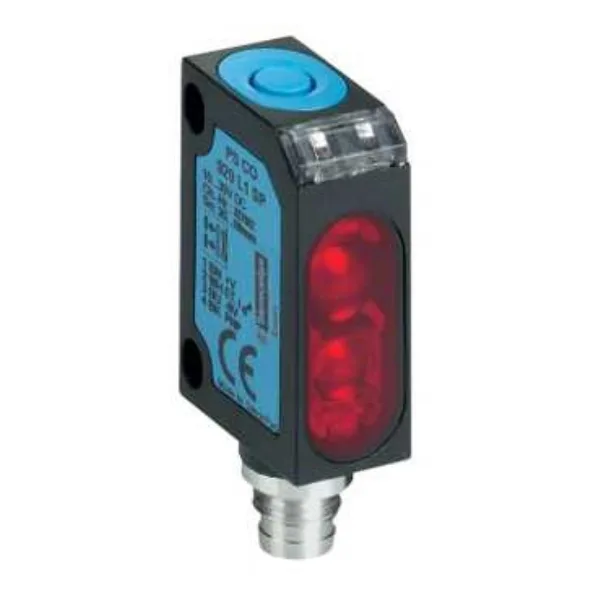
The Square D / Telemecanique OsiSense XUM XUYPSCO929L1SP is a polarized reflex photoelectric sensor: emitter and receiver share one housing, and the beam returns off a dedicated reflector. PBT body, polycarbonate lens, IP67 sealed, solid-state PNP NO/NC on a 3-wire pigtail. The ordering description reads Telemecanique XUMTAPCNL2; XUYPSCO929L1SP is the orderable code on the carton and BOM. Running on 12 to 24 VDC, the sensor switches a 100 mA load through the PNP output, which is the typical ceiling for a PNP switching input on most PLC cards and small relay coils. Response time sits at 1 ms, so it is comfortable on conveyor registration, small-parts detection, and end-of-stroke confirmation on pneumatic slides — too slow for high-speed counting on a bottling line, plenty fast for case-packing and pallet-out gates. Sensing distance is rated 1 m with the XUZC50CR reflector and 2 m with the XUZC50 — pick the reflector to match the throw you actually need, because the polarized filter on the receiver is what rejects shiny targets bouncing light back into the housing. Connection is a fixed 2 m cable out the back, not a connector. Routing length, cable gland, and service loop have to be planned at panel build. Operating temperature spans -13 to 131 °F, and two LEDs on top let the field tech read output and power state without a meter.
Approvals and environmental envelope
UL listed for Canada and the US and CE marked per the listing. IP67 enclosure rating covers dust-tight and temporary immersion. Operating temperature is -13 to 131 °F.
How it sits on the panel and what to plan around
The 2 m cable is the only wiring interface on this XUM block housing. The PNP NO/NC 3-wire hookup uses brown, blue, and black leads on 12-24 VDC. Output is rated 100 mA solid-state with a 1 ms response. Reach is the variable that decides the bracket and reflector hardware order. At 1 m on the XUZC50CR reflector the beam is forgiving of small misalignment, which is what you want on a conveyor where vibration walks the bracket over time. At 2 m on the XUZC50 the polarization matters more — shiny shrink-wrap and clear PET bottles will still trigger the sensor because the polarized optic reads the reflector pattern, not the target, but a mirror-finish part passing close to the reflector can fool it. For a typical case-detection job on a 24 VDC control bus, the XUZC50CR at 1 m is the safe call; spec the XUZC50 only when the geometry forces a longer throw.