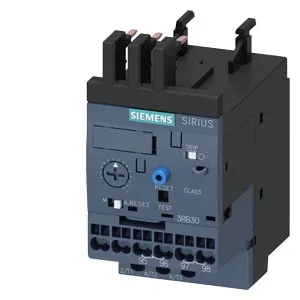
Active production — CLASS 10E solid-state trip for motor protection
The 3RB3016-1NE0: Rated thermal current is 1.25 A at 690 V (AC-3e), suitable for small motor loads up to about 0.37 kW at 400 V. The electronic overload release provides temperature-compensated tripping across the full -25 to +60 °C operating range, so the protection curve stays accurate regardless of ambient heat near the starter.
Panel integration — spring-loaded terminals, contactor-mount, any position
Mounts directly onto a contactor via the fastening method, eliminating separate DIN-rail space. Accepts 2× (0.25 to 1.5 mm²) solid or stranded wire through spring-loaded terminals — no screw torque required, just push the stripped conductor in. The Pozidriv PZ 2 screwdriver tip with 5–6 mm shaft diameter is specified for the release button and auxiliary terminal access. Dimensions are 45 mm wide, 72 mm high, 90 mm deep — the S00 footprint matches the Siemens 3RT2 contactor series. Mounting position is any orientation, so panel layout is flexible. Vibration resistance is 1–6 Hz at 15 mm amplitude and 6–500 Hz at 20 m/s² for 10 cycles; shock resistance is 15 g for 11 ms per IEC 60068-2-27.
Auxiliary contact ratings and signalling
An integrated auxiliary switch provides the tripped signal on terminals 97/98. Contact ratings vary by voltage: 2 A at 24 V DC, 4 A at 120 V AC, 3 A at 230 V AC, and 0.55 A at 60 V DC. The note "for message 'tripped'" means this contact closes when the relay has operated — use it to trigger a PLC input, alarm lamp, or safety chain. Power dissipation per pole is 0.03 W, negligible for panel thermal budgeting. The auxiliary circuit draws minimal current from the control supply, allowing direct connection to a 24 V DC PLC input module without an intermediate relay.
Environmental tolerance and compliance
Operating temperature range is -25 to +60 °C with full temperature compensation; storage and transport range is -40 to +80 °C. Substance prohibitance date is 10/01/2009, indicating RoHS compliance from that date forward. The operating frequency is 50/60 Hz, covering standard industrial mains.