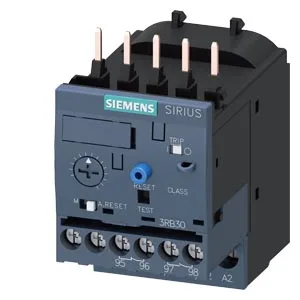
The Siemens 3RB3016-1TB0 is a SIRIUS solid-state overload relay sized S00, rated for a continuous thermal current of 16 A and a CLASS 10E trip characteristic. It mounts directly onto a matching contactor (contactor mounting, per the spec), so it pairs with S00-frame contactors in a motor starter stack without extra brackets or wiring between the relay and the contactor's main poles. The electronic overload release means it measures motor current through the power poles and uses a solid-state circuit to model the thermal rise, rather than a bimetallic strip. That gives it better repeatability and a tighter tolerance band across the ambient range, with temperature compensation active from -25 to +60 °C. Rated insulation voltage is 690 V, and the relay carries its full 16 A rating at both 480 V and 600 V, so it handles 480 V and 600 V motor circuits without derating the current — useful on North American 480/277 V or 600 V industrial feeds.
CLASS 10E means the relay will trip within 10 seconds at 7.2× the set current (the standard definition for Class 10 motor protection). That is fast enough to protect a standard squirrel-cage induction motor during a locked-rotor event, but it is not the faster Class 5 or 2 you might need for submersible pumps or hermetically sealed compressors. For a general-purpose conveyor or fan motor, Class 10 is the usual spec. The 16 A thermal current is the maximum continuous current the relay can carry through its power path. Auxiliary contacts are integrated and rated for switching: 2 A at 24 V, 0.55 A at 60 V, 0.3 A at 110/125 V, 0.11 A at 220 V, and 4 A at 120 V, 3 A at 230 V (–).
Deployment context and approvals
This relay is built for a motor control center or a standalone starter bucket. The S00 frame size keeps the footprint compact: 45 mm wide, 79 mm tall, 73 mm deep. Mounting position is any, which helps in tight enclosures where you cannot guarantee vertical orientation. Vibration resistance is spec'd at 1–6 Hz, 15 mm amplitude, and 6–500 Hz at 20 m/s² for 10 cycles; shock resistance is 15 g for 11 ms. That covers most industrial environments — pumps, conveyors, fans — but if your application involves repetitive high-G impacts (a stamping press, a rock crusher), you might want to check the signaling contact's lower shock rating of 9 g when tripped. Wire termination is screw-type terminals accepting 1× 0.5–4 mm² or 2× 0.5–2.5 mm² solid or stranded. The screwdriver spec calls for a PZ2 Pozidriv tip with a shaft diameter of 5 to 6 mm. That is standard for panel builders — no oddball tool needed.