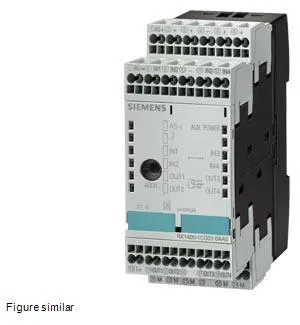
AS-Interface I/O module for the control cabinet
The Siemens 3RK1402-3CG01-0AA2 is a standard AS-Interface slave module from the SlimLine S22.5 series, packing 4 PNP digital inputs and 4 solid-state switching outputs into a 45 mm wide housing that snaps onto 35 mm DIN rail or mounts directly to a panel wall using push-in lugs. Each of the four I/O channels — D0 through D3 — is a floating pair (one input, one output), so you get four independent signal paths that can be wired to different potentials without commoning them up. The module requires an external auxiliary supply of 20 to 30 V DC, compliant with VDE 0106 (PELV) protection class III, to power both the input and output circuits — the AS-Interface bus cable alone won't drive the outputs.
The 4 A aggregate current maximum across all four outputs sets the total load the module can switch — not per-channel, but the sum of all outputs running at once. If you're driving four solenoids that each draw 1.2 A, you're over the limit; plan for a distribution block or a higher-current slave. Output voltage at 24 V DC sits between 22 and 24 V, so the module doesn't boost or regulate — it passes through the auxiliary supply voltage minus a small drop. That means the load sees whatever your PELV supply delivers, so keep the supply stiff and the wiring short if you're driving devices near their undervoltage threshold. The PNP input circuit expects a positive-going signal from a sourcing sensor or pushbutton — it won't see an NPN sinking output without a pull-up resistor. The signal threshold is 5 mA minimum for a logic '1' and 1.5 mA maximum for a logic '0', which is standard for 24 V PLC-level inputs. Built-in watchdog, short-circuit protection, and induction suppression mean the module handles the common fieldbus headaches internally — no external clamp diodes or fuses needed per channel for typical inductive loads.
Mounting and wiring in the panel
The spring-loaded terminal connections accept 2 x (0.25 to 1.5) mm² solid or stranded wire, or 2 x (0.25 to 1.0) mm² with end sleeves, and a detachment tool is needed for release. IP20 protection means it's for the clean, dry control cabinet only — no washdown, no dust, no outdoor exposure. The addressing is done via a front socket, and the ID/ID2 code is set to 0/F, which is the default for a standard 4I/4O slave. Status LEDs on the front panel give you the essentials: green for AS-Interface communication, yellow per I/O channel for signal state, and red for a fault condition. That's enough for a quick line-side check without dragging out a laptop.