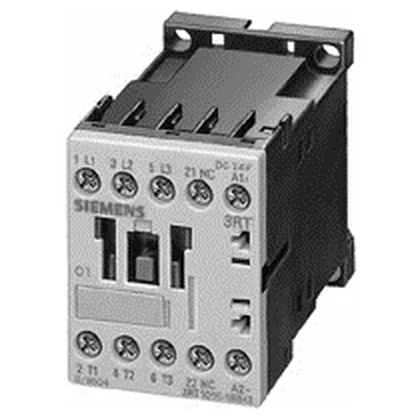
The 24 VDC coil pulls in at 0.85 x rated voltage and drops out at 1.1 x rated voltage, so it holds reliably on a 24 V supply but releases cleanly when the control signal goes high — that 1.1 dropout factor means it won't chatter on a floating ground. Rated for 4 kW at 690 V AC-3 duty, it handles a 3-phase motor up to that power level; the AC-4 rating at 400 V is 6.5 A, which covers reversing or inching applications where the contactor makes and breaks the load under full current. The screw-type main terminals accept 2x (0.5 to 1.5 mm²), 2x (0.75 to 2.5 mm²), or max 2x (0.75 to 4 mm²) — solid or stranded — and the AWG equivalent is 2x (20 to 16), 2x (18 to 14), or 1x 12. That covers most panel wiring up to 4 mm² without needing ferrules, though for stranded wire a ferrule keeps the strands together under the screw. The coil draws 3.3 W closing and 3.3 W holding DC, so the power supply needs to deliver that continuously; no surge at pickup beyond the steady-state draw.
The 45 mm width and 57.5 mm height fit the standard S00 footprint; depth is 72 mm, which leaves room for wiring in a 200 mm deep enclosure.
The AC-12 resistive rating is 10 A, which covers heater or lighting loads where the contactor switches steady-state current without motor inrush. Mechanical life is 30 million operating cycles, so for a line cycling once every 10 seconds that's about 9.5 years of continuous service before the contacts wear out.