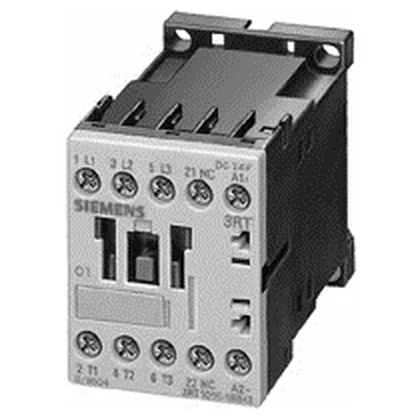
The 3RT1016-1AN21: The AC-2 rating (4 kW at 400 V) covers wound-rotor motor starting and braking — a duty that demands higher contact endurance than standard AC-3. The AC-4 rating (8.5 A at 400 V) handles reversing and inching, where contacts must interrupt full load current frequently. For resistive or lightly inductive loads, the AC-1 rating at 24 V is 10 A, but at 230 V it drops to 6 A and at 400 V to 3 A — so the same contactor carries less current as voltage rises, which is typical for this class. The coil holds at 24 VDC nominal; the operating range is 0.8–1.1 × rated voltage at 50 Hz (0.85–1.1 at 60 Hz), so the coil stays pulled in down to about 19.2 VDC.
The 45 mm wide, 57.5 mm tall, 72 mm deep footprint fits standard 35 mm DIN rail (EN 50022) with screw or snap-on fastening. Side-by-side mounting is allowed, so multiple contactors pack tightly on the rail without required spacing — useful for dense motor starter assemblies.
Type 2 coordination (which limits damage to the contactor after a fault) requires a 20 A gL/gG fuse. This means the upstream fuse must be sized to the coordination type the designer specifies — Type 2 is more restrictive but keeps the contactor reusable after a fault. The contactor carries IP20 protection on the front and terminals, so it is finger-safe inside an enclosure but not washdown-rated.